Introduction
In 2026, a typical residential or multi-family project often reaches a familiar decision point late in the design process. Floor plans are finalized, elevations are approved, and most major material packages are locked in. Attention then turns to interior doors—often treated as a standard item, yet capable of influencing cost control, installation efficiency, and overall perception of quality. At this stage, builders and purchasing teams usually narrow their options to three categories: traditional molded doors, classic Shaker doors, and the increasingly common Shaker-style molded doors. While these options may appear similar on paper, their implications become more pronounced when applied across an entire project.
The way builders choose among these doors in 2026 is no longer driven by style alone. Decisions are shaped by project type, labor conditions, budget predictability, and buyer expectations. Molded doors remain the most efficient solution for cost-driven projects. True Shaker doors are still relevant when architectural detail is a clear selling point. Shaker-style molded doors have emerged as a middle-ground option, offering a Shaker-like appearance while aligning more closely with modern construction workflows. Understanding how each door type fits within different project contexts is now a practical, system-level decision.
Door Type Definitions: Clarifying the Terminology
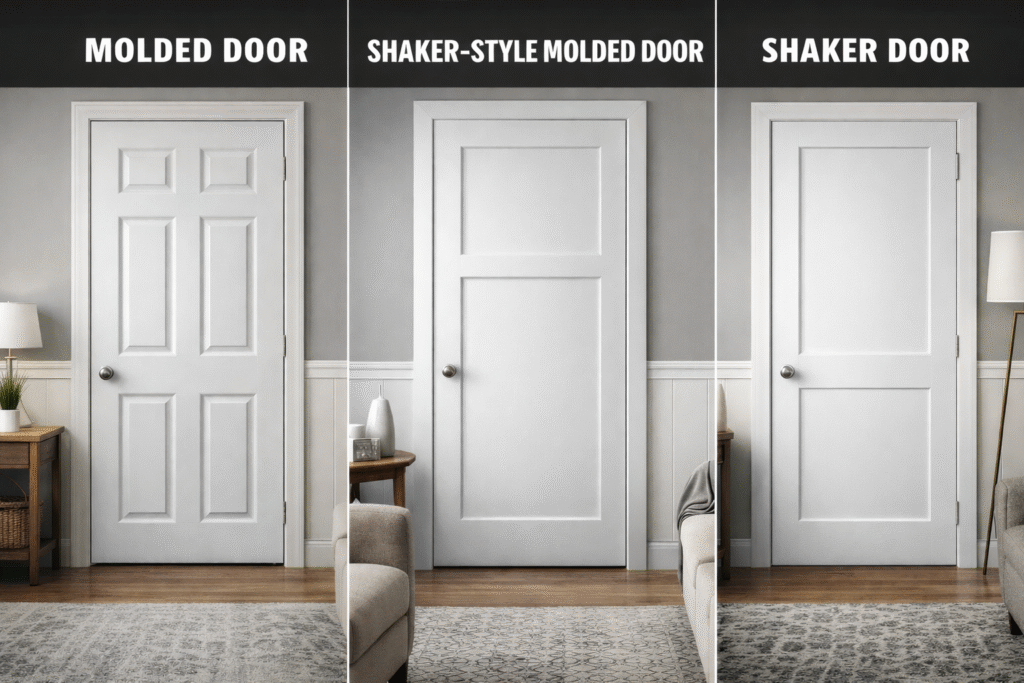
Although the terms molded, Shaker, and Shaker-style molded are often used interchangeably, they describe different construction methods and design intentions.
Molded doors are produced using pressed door skins, with panel details formed as part of a single-piece face. Their primary advantage is consistency. Dimensions, tolerances, and appearance remain uniform across large quantities, making them well suited for projects where repetition and speed matter more than architectural detail.
Shaker doors are defined by their frame-and-panel construction, consisting of separate rails, stiles, and a flat center panel. This structure creates deeper reveals and more pronounced shadow lines, which contribute to a higher perceived level of craftsmanship. However, the same construction also introduces more variables in production, handling, and installation—factors that become increasingly relevant as project scale grows.
Shaker-style molded doors combine elements of both. They are molded doors by construction, but the molded profile is designed to replicate the proportions of a Shaker door. This allows builders to achieve a familiar Shaker appearance while maintaining the consistency and efficiency associated with molded products.
Cost Structure Comparison: Where the Differences Matter
When comparing molded, Shaker, and Shaker-style molded doors, builders rarely evaluate cost on unit price alone. The more meaningful differences appear when material cost, labor exposure, and budget predictability are considered together at the project level.
Cost Comparison Overview
| Factor | Molded Doors | Shaker-Style Molded Doors | True Shaker Doors |
|---|---|---|---|
| Typical Unit Cost | Lowest | Mid-range | Highest |
| Cost Consistency at Scale | Very high | High | Moderate |
| Installed Cost Sensitivity | Low | Low to moderate | High |
| Labor Requirement | Minimal | Minimal to moderate | Higher |
| Tolerance for Installation Variability | High | High | Lower |
| Budget Predictability | Very strong | Strong | Moderate |
| Perceived Upgrade by Buyers | Low | Medium to high | High |
| Cost-to-Perceived-Value Ratio | Moderate | Strong | Variable |
How Builders Use This Comparison
On a per-door basis, molded doors remain the most cost-effective option, particularly in large-volume projects. Their strength lies in predictability: pricing is stable, installation requirements are minimal, and performance is consistent from estimating through completion.
Shaker-style molded doors typically occupy the middle ground. While unit pricing is higher than traditional molded doors, they often deliver a stronger perceived upgrade without materially increasing labor risk. For many builders, this balance makes them easier to justify across an entire project.
True Shaker doors carry the highest material and installed cost. While they provide the greatest visual depth and architectural definition, they are also more sensitive to labor conditions and installation quality. As a result, their cost impact is more variable and generally requires clearer justification tied to project positioning.
Design Expectations in 2026: What Buyers Notice
From the buyer’s perspective, doors are rarely focal points on their own. Their visual impact depends heavily on context—lighting, trim profiles, wall color, and overall layout all influence how noticeable door details become.
Shaker design has shifted from a trend to a baseline expectation. Buyers continue to associate framed doors with quality and familiarity, even if they cannot clearly articulate structural differences. The visual upgrade from a flat molded door to a Shaker-profile door is immediately apparent, while the difference between a Shaker-style molded door and a true Shaker door is often subtle.
This gap between perception and construction reality gives builders greater flexibility when selecting door types, especially in price-sensitive segments.
Common Use Cases by Project Type
Door selection logic varies significantly by project type.
In multi-family and apartment projects, scale and consistency dominate decision-making. Molded doors remain common, while Shaker-style molded doors are increasingly used to introduce visual structure without increasing labor exposure. True Shaker doors are typically limited to premium units or shared spaces.
For entry-level single-family homes, buyers respond positively to visible upgrades but remain cost conscious. Shaker-style molded doors fit well in this segment, while molded doors are often used in secondary spaces such as closets or utility areas.
In mid-range and semi-custom homes, interior detailing carries more weight. True Shaker doors are more frequently justified as part of a broader architectural package, though mixed door strategies are often used to manage budgets efficiently.
Renovation and flip projects prioritize speed and resale appeal. Shaker-style molded doors are popular due to availability, ease of installation, and familiar aesthetics, while true Shaker doors are used selectively when they support a clear pricing strategy.
How Builders Are Choosing in 2026
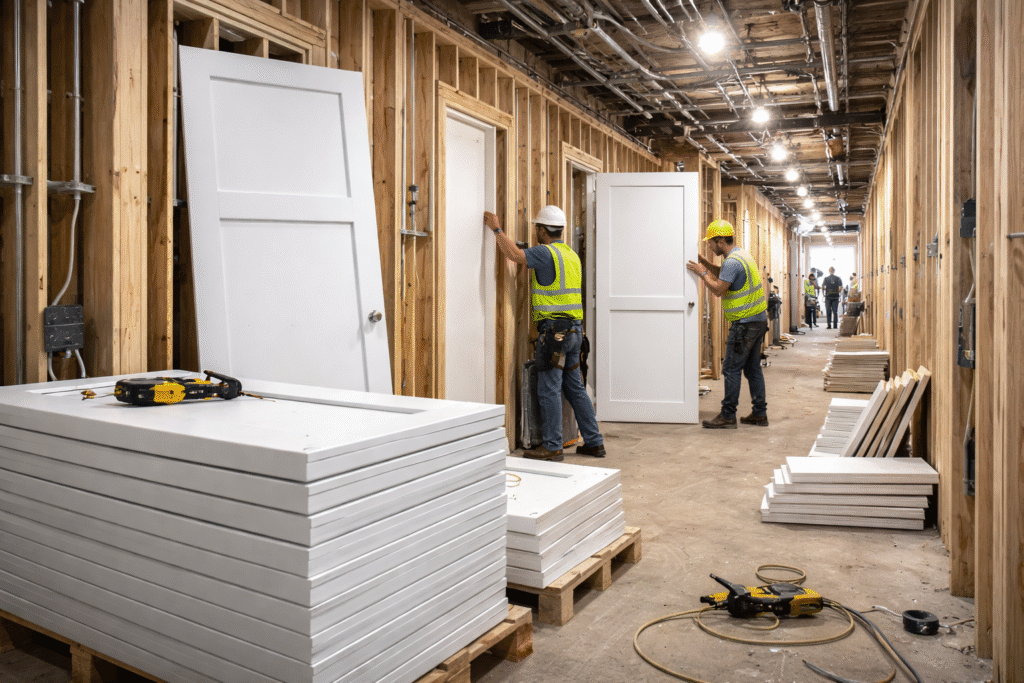
Across all segments, builders are moving away from single-category decisions. Mixed door specifications within the same project are increasingly common, with door types assigned based on visibility and functional importance.
At the same time, decision-making has become more system-oriented. Doors are evaluated not just as products, but as components within a construction workflow that includes labor availability, scheduling, and risk management. In this context, Shaker-style molded doors often emerge as a practical compromise, while true Shaker doors are applied more selectively and intentionally.
Conclusion
In 2026, choosing between molded, Shaker, and Shaker-style molded doors is less about preference and more about context. Molded doors support projects where efficiency and predictability are critical. True Shaker doors remain relevant when architectural detail is central to the value proposition. Shaker-style molded doors bridge the gap between appearance and execution. For builders, the most effective decisions are made at the project level—balancing cost, labor, and perceived value rather than relying on door category alone.
Frequently Asked Questions About Molded and Shaker Doors
Q: What is the difference between a “True Shaker” and a “Shaker-Style Molded” door?
A: A True Shaker door is constructed using separate pieces of wood (stiles, rails, and a flat center panel) joined together. A Shaker-style molded door is manufactured from a continuous sheet of high-density fiberboard pressed to look exactly like a Shaker door. Because the molded face is one seamless piece, it will never experience the joint separation or paint cracking that can happen with traditional stile-and-rail doors.
Q: Why are Shaker-style molded doors so popular with builders in 2026?
A: They offer the ultimate balance of high-end aesthetics and profit margin. They deliver the clean, square-edged, minimalist look that modern homebuyers demand, but at a significantly lower cost than true stile-and-rail doors. For multi-family developments or volume builds, this drastically lowers the budget without making the interior look “cheap.”
Q: Should I choose a smooth or textured finish for modern molded doors?
A: Smooth. While faux wood-grain textures were the standard in the past, the 2026 North American market heavily favors a crisp, smooth finish. A smooth Shaker-style molded door mimics the look of high-end painted wood, fits perfectly with modern baseboards, and is much easier to wipe clean.
Q: Can a molded door feel as premium as a real wood door?
A: Yes, if you specify the core correctly. While standard hollow-core molded doors are lightweight, upgrading to a Solid Core molded door changes everything. It provides the heavy, premium swing and excellent noise reduction (STC rating of ~32+) of real wood, while the molded skin keeps the overall cost highly competitive.
Articles that you may be interested in:
How to Choose Interior Doors for Apartments, Condos & Townhomes
Interior Door Buying Guide: Materials, Styles, and Costs
How Can Builders Ensure Quality When Sourcing Doors, Cabinets, Mouldings, and Flooring?