Introduction
In a large-scale residential project, cost decisions rarely hinge on aesthetics alone. Consider a builder planning a 200-unit multifamily development. With an average of six interior doors per unit, the project requires approximately 1,200 doors. At first glance, the price difference between molded and Shaker doors may appear manageable on a per-unit basis. However, when multiplied across the entire scope, even a moderate price gap becomes a significant budget variable. What seems like a minor upgrade at the unit level can translate into tens of thousands of dollars at the project level.
From a straightforward cost perspective, molded doors are typically less expensive than Shaker doors. Their manufacturing process relies on pressed skins and standardized assembly, resulting in lower material input and reduced labor intensity. Shaker doors, built with frame-and-panel construction, require more machining, more assembly steps, and more finishing work. As a result, Shaker doors generally carry a higher factory price. In most North American wholesale markets, Shaker doors cost approximately 15–35% more than comparable molded doors. The critical question, however, is whether that difference remains significant once installation, logistics, and market positioning are considered together.
Construction Differences: Why Cost Structures Diverge
The price gap between molded and Shaker doors begins at the structural level.
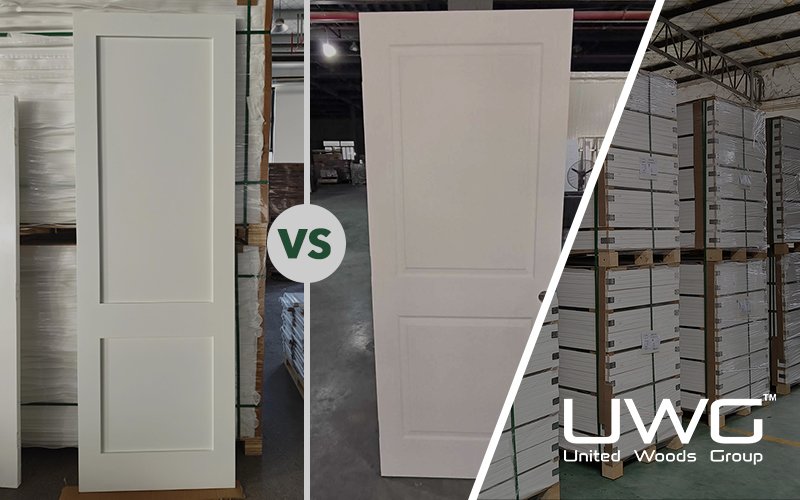
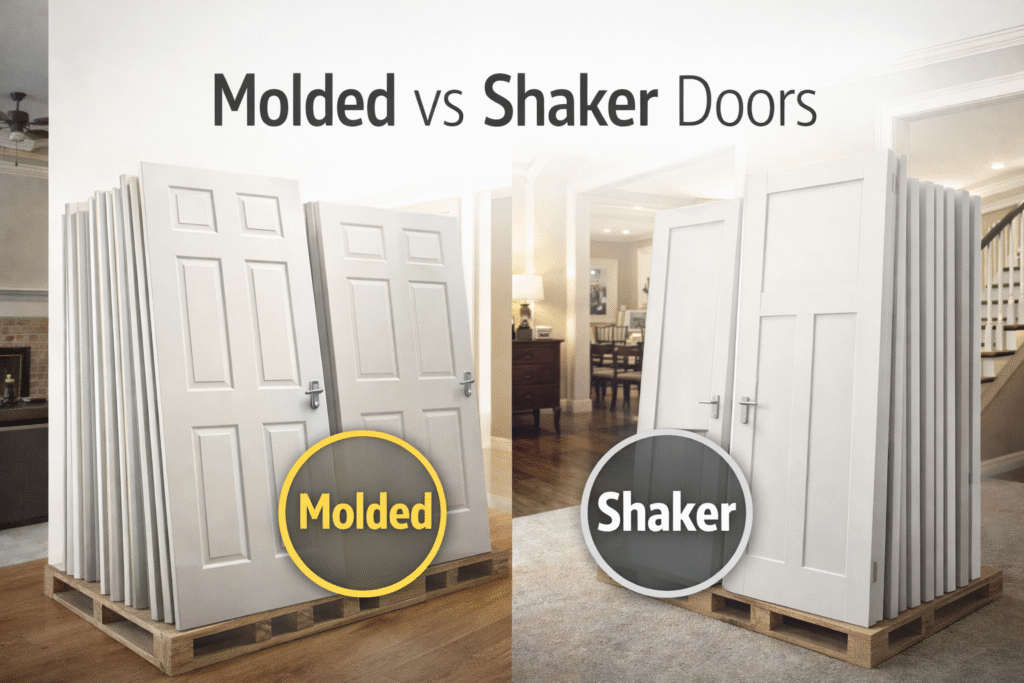
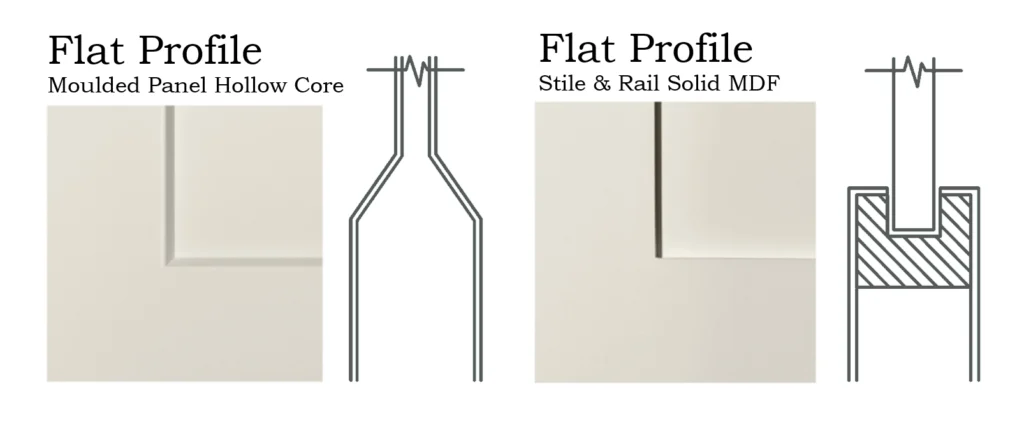
Molded doors use a pressed skin process in which panel details are formed as part of a single surface. The core—whether hollow, solid, or engineered—sits between two molded skins. This process benefits from automation, repeatability, and scale efficiency. Because panel definition is created during pressing, there are fewer machining steps and lower assembly complexity.
Shaker doors are built using rail-and-stile construction. Separate vertical stiles and horizontal rails frame a flat center panel. This creates deeper reveals and more defined shadow lines, contributing to a stronger architectural appearance. However, the multi-piece construction increases machining requirements, alignment precision, sanding time, and finishing exposure. Each additional process step introduces labor cost and potential variability.
In short, molded doors are optimized for production efficiency, while Shaker doors are structured around design depth.
Factory-Level Cost Comparison
At the factory level, three components primarily drive the cost difference: material consumption, labor input, and finishing requirements.
Material Usage
Shaker doors typically consume more MDF or solid wood components due to their framed construction. The rails and stiles must maintain structural integrity and consistent dimensional stability. Molded doors, especially hollow-core models, require less raw material per unit, lowering baseline cost.
Labor Intensity
Molded doors benefit from automated pressing and streamlined assembly lines. Shaker doors involve routing, joint assembly, sanding, and surface preparation across multiple parts. Labor hours per unit are therefore higher, particularly for doors requiring tight tolerances or premium finishing.
Surface Finishing
Finishing cost also diverges. Because Shaker doors have sharper profile edges and deeper panel lines, they often require more attention during priming and sanding to achieve uniform coverage. Molded surfaces, being continuous and smoother, are generally faster to process.
For wholesale buyers evaluating FOB pricing, these differences translate into measurable cost gaps. While exact figures vary by specification and core type, Shaker doors consistently price above molded doors within the same quality tier.
Installation and On-Site Cost Impact
Unit cost alone does not determine overall project expense. Installation conditions significantly influence total expenditure.
Molded doors offer high tolerance for installation variability. Their consistent thickness and pressed panel faces reduce alignment sensitivity. In high-volume projects where crews prioritize speed, this predictability minimizes rework risk.
Shaker doors, due to their framed construction, can be more sensitive to handling and site conditions. Misalignment, joint stress, or moisture fluctuation may affect appearance if installation is not carefully controlled. While properly manufactured Shaker doors perform reliably, they demand slightly higher installation discipline.
When multiplied across hundreds of openings, small differences in installation time or adjustment rates can affect labor budgets. In tight labor markets, this factor becomes increasingly relevant to builders managing schedule risk.
Logistics and Volume Efficiency
Weight and load efficiency also influence comparative cost.
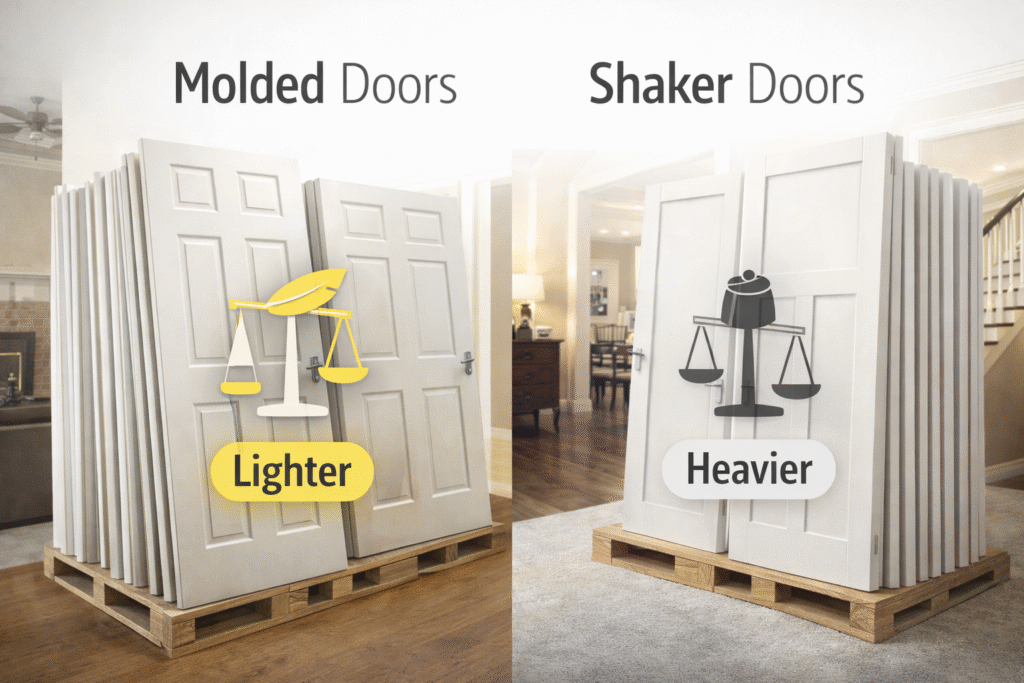
Hollow-core molded doors are typically lighter than solid or engineered-core Shaker doors. This difference affects both freight density and handling efficiency. Lighter doors allow for higher loading quantities per container, improving transportation cost per unit.
Heavier framed doors, particularly in solid-core configurations, reduce container loading efficiency and may increase freight exposure on a per-door basis. While shipping cost is not the dominant factor in most projects, it contributes incrementally to overall landed cost.
For importers operating at scale, small efficiency differences in container utilization can compound across annual purchasing volumes.
Market Positioning and Perceived Value
Cost comparison becomes more complex when buyer perception is introduced.
Shaker styling has evolved into a baseline expectation in many North American markets. Even entry-level buyers increasingly associate framed panel doors with a more contemporary or higher-quality interior. The visual difference between a flat molded door and a Shaker door is immediate and noticeable.
However, the perceived distinction between a molded Shaker-look door and a true rail-and-stile Shaker door is often subtle. For many end buyers, the structural difference is less visible than the overall design language. This perception gap influences how builders justify cost differences.
If a moderate cost increase meaningfully enhances resale positioning, the premium may be defensible. If not, molded doors may remain the more efficient choice.
Cost Comparison Summary
When evaluated strictly on upfront price, molded doors are the lower-cost option. Their manufacturing efficiency, reduced labor exposure, and strong installation predictability make them particularly suitable for large-scale, cost-sensitive developments.
Shaker doors command a higher factory price due to their material structure and production complexity. They introduce deeper visual definition and stronger architectural presence but require greater labor input both in manufacturing and potentially during installation.
For builders and wholesalers, the decision should not rely solely on category. The appropriate choice depends on project positioning, buyer expectation, labor conditions, and total cost tolerance.
In purely financial terms, molded doors win on upfront efficiency. In perceived value terms, Shaker doors often provide stronger market differentiation. The most cost-effective decision is ultimately project-specific, determined by how much design value justifies incremental cost.