When planning or supplying materials for a residential apartment project, one of the most practical and frequently asked questions is: How many interior doors are typically required?
For developers, contractors, and door suppliers, accurately estimating interior door quantities is essential for budgeting, procurement planning, production scheduling, and logistics coordination. Miscalculations can result in cost overruns, delays, or material shortages — especially in multi-unit projects.
The number of interior doors in an apartment project varies depending on unit layout, unit size, building positioning, and design standards. This article provides a systematic breakdown of how to calculate interior door quantities in a typical apartment development, helping you plan more accurately and improve project efficiency.
In a typical apartment project, each unit generally contains between 5 to 10 interior doors, depending on layout and size. A one-bedroom unit usually requires 5–6 doors, a two-bedroom unit 6–8 doors, and a three-bedroom unit 8–10 doors, including bedroom doors, bathroom doors, closet doors, and utility room doors. For a 100-unit apartment building, total interior door demand often ranges from 600 to 800 doors. Exact quantities depend on floor plan design, local standards, and project specifications.
1. Understanding What Counts as an Interior Door
Before calculating quantities in an apartment project, it is essential to clearly define what qualifies as an interior door. Inaccurate scope definition is one of the most common causes of procurement miscalculations.
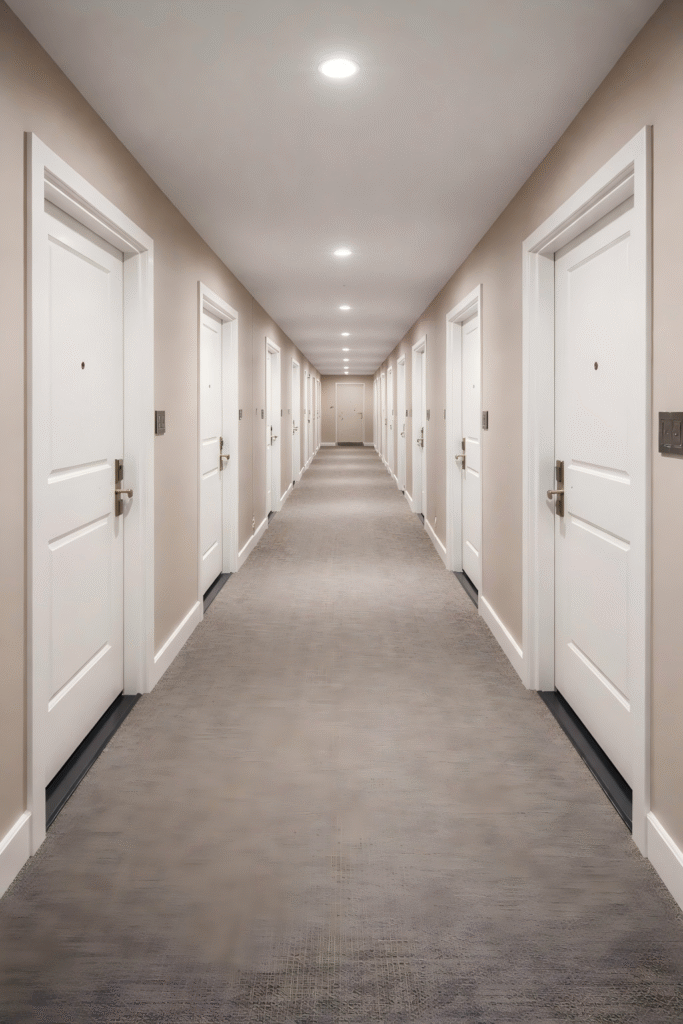
Interior Doors Typically Include:
- Bedroom swing doors
- Bathroom doors
- Study room doors (if applicable)
- Kitchen doors (in enclosed layouts)
- Walk-in closet doors
- Wardrobe bi-fold or swing doors
- Laundry room doors
- Storage room doors
In high-density apartment developments, even small enclosed utility spaces often require doors due to fire code or acoustic requirements.
Interior Doors Typically Exclude:
- Main apartment entry doors (exterior/fire-rated)
- Stairwell doors
- Elevator lobby doors
- Corridor access doors
- Mechanical shaft or electrical room doors
- Amenity space doors (unless included in supply scope)
For accurate door quantity estimation in apartment projects, always verify:
- Architectural floor plans
- Door schedules
- Reflected ceiling plans (to identify hidden storage rooms)
- Local building codes
Door schedules provided by architects are the most reliable source for final numbers, but early-stage budgeting often requires estimation before drawings are finalized.
2. Interior Door Quantity Per Apartment Unit
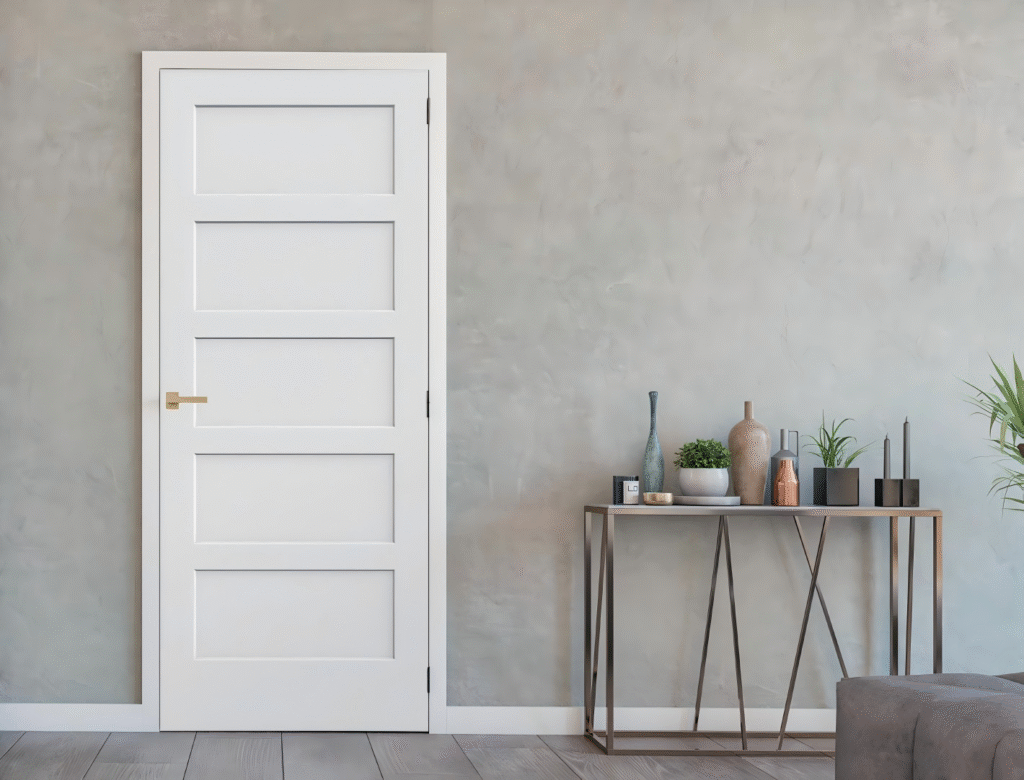
- Unit size
- Bedroom count
- Bathroom configuration
- Storage strategy
- Market positioning (budget vs. luxury)
Below is a more structured breakdown for practical estimation.
A. Studio Apartment (400–600 sq ft)
Studios are typically open-plan layouts with minimal partition walls.
Typical enclosed spaces:
- Bathroom: 1 door
- Entry closet: 1 door
- Storage room (optional): 1 door
If no additional storage exists, the minimum configuration is just 2 interior doors.
Average total: 2–4 interior doors
Luxury studios with separated sleeping zones may increase this to 4–5 doors.
B. One-Bedroom Apartment (600–900 sq ft)
This is one of the most common configurations in urban rental markets.
Typical enclosed spaces:
- Bedroom: 1 door
- Bathroom: 1 door
- Closet(s): 1–2 doors
- Laundry/storage: 1 door
- Kitchen (if enclosed): 1 door
Average total: 5–6 interior doors
In value-engineered rental projects, developers often reduce closet enclosures to sliding systems to lower cost and reduce swing clearance requirements.
C. Two-Bedroom Apartment (850–1200 sq ft)
Two-bedroom units dominate family-oriented developments.
Typical configuration:
- Bedroom 1: 1 door
- Bedroom 2: 1 door
- Shared bathroom: 1 door
- Master en-suite bathroom: 1 door
- Closets: 2–3 doors
- Laundry/storage: 1 door
Average total: 6–8 interior doors
In higher-end projects with walk-in closets and separate linen storage, the number may reach 8–9 doors.
D. Three-Bedroom Apartment (1100–1500 sq ft)
Larger units introduce additional enclosed functional spaces.
Typical configuration:
- 3 bedrooms: 3 doors
- 2 bathrooms: 2 doors
- Closets: 2–4 doors
- Laundry room: 1 door
- Storage room (optional): 1 door
Average total: 8–10 interior doors
Premium projects may exceed 10 doors per unit due to:
- Separate pantry rooms
- Home office rooms
- Mechanical closets
- Dual walk-in closets
3. Calculating Total Interior Doors for a Full Project
In multi-unit apartment developments, total interior door demand scales quickly.
Let’s analyze a 100-unit project:
- 40 one-bedroom units (avg. 6 doors) → 240 doors
- 40 two-bedroom units (avg. 7 doors) → 280 doors
- 20 three-bedroom units (avg. 9 doors) → 180 doors
Total interior doors = 700 doors
However, professional estimation should also consider:
- Model units (1–3 units)
- Leasing office spaces
- Clubhouse rooms
- Fitness rooms
- Public restrooms
- Electrical rooms within residential floors
Adding these spaces may increase total door demand by 5–12%.
For projects between 80–150 units, interior door quantity typically falls between:
600–1,200 doors
For 200+ unit developments, it is common to exceed 1,500–2,000 interior doors.
4. Additional Factors That Affect Door Quantity
Interior door planning in apartment projects is not only layout-driven but also influenced by design philosophy and regulations.
A. Open vs. Closed Kitchen Layout
Open kitchens reduce one door per unit, which can significantly reduce total demand across large projects.
For example:
In a 200-unit development, eliminating kitchen doors saves 200 doors.
B. Closet Design Strategy
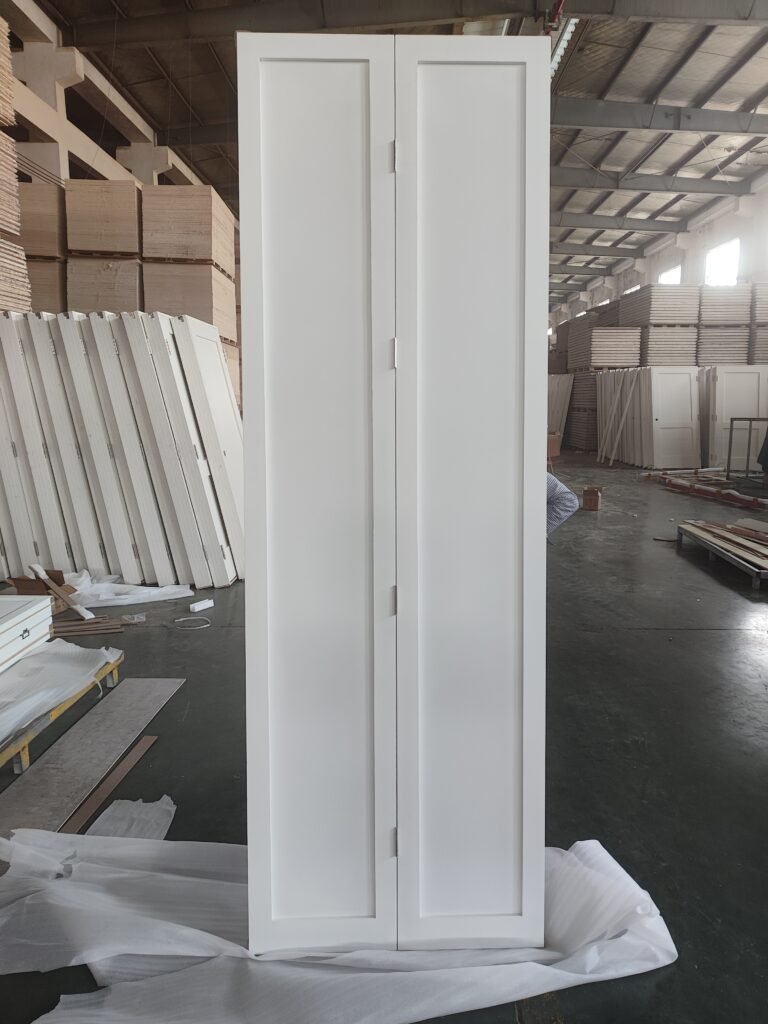
Options include:
- Swing doors
- Bi-fold doors
- Sliding bypass systems
- Open wardrobe systems
Switching to open wardrobe systems may reduce door count by 10–15% per project.
C. Fire Code Requirements
Some jurisdictions require:
- Fire-rated doors for utility closets
- Self-closing hardware
- Smoke-seal requirements
These do not increase quantity but affect specification and cost.
D. ADA and Accessibility Standards
Accessible units typically require:
- 32” minimum clear opening width
- Lever hardware
While this may not increase door count, it affects size distribution planning.
E. Market Positioning
Luxury apartment projects often increase door counts by including:
- Dedicated study rooms
- Separate pantry spaces
- Larger walk-in closets
Budget-driven rental projects prioritize efficiency and reduce enclosed spaces.
5. Typical Door Size Distribution
Interior door size planning plays a critical role in manufacturing optimization.
Most common sizes in apartment projects:
- 24” x 80” – Bathrooms
- 28” x 80” – Secondary bedrooms
- 30” x 80” – Primary bedrooms
- 32” x 80” – ADA units
- 18”–24” – Closets
In most mid-rise projects, size distribution often follows this approximate ratio:
- 30” doors: 35–40%
- 28” doors: 25–30%
- 24” doors: 15–20%
- Closet sizes: 10–15%
- 32” ADA doors: 5–8%
Understanding this ratio helps:
- Improve production batching
- Optimize container loading
- Reduce leftover inventory
6. Hollow Core vs. Solid Core Selection
Door type selection significantly impacts project budget and logistics.
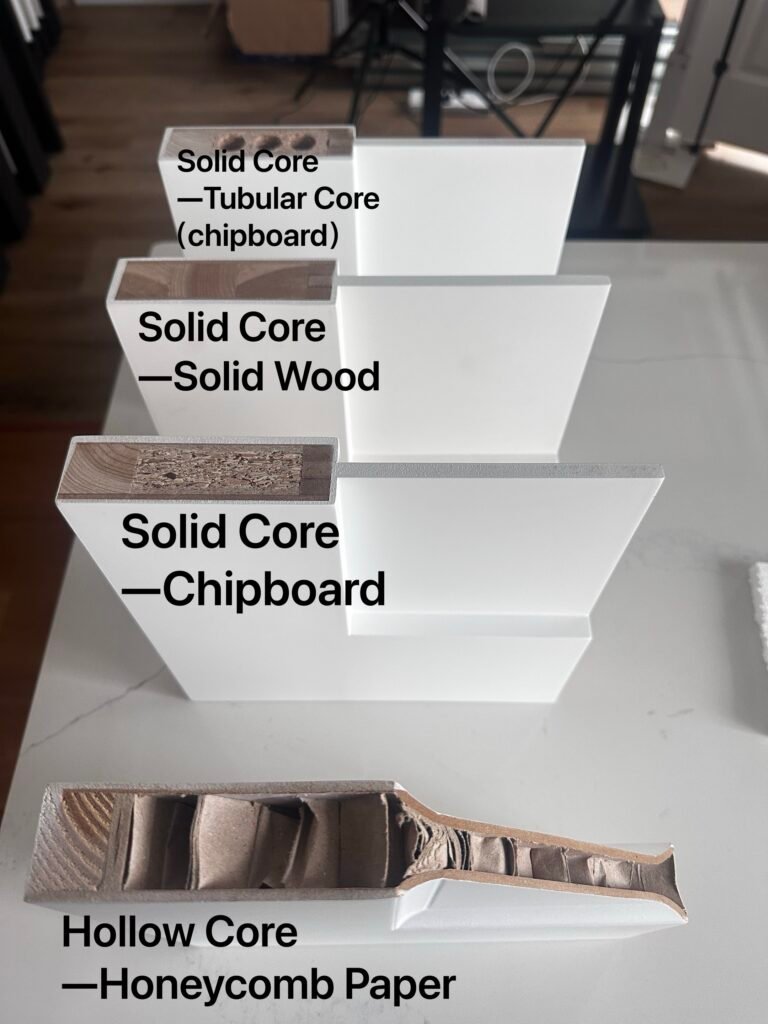
Hollow Core Doors
- Lower material cost
- Reduced shipping weight
- Easier installation
- Common in rental apartments
Solid Core Doors
- Superior acoustic performance
- Better durability
- Higher-end market perception
- Often required between bedrooms and bathrooms in luxury units
For large-scale sourcing, weight difference affects:
- Container loading capacity
- Freight cost per unit
- Labor handling requirements
7. Procurement and Planning Strategy
Interior doors are high-volume standardized components. Strategic planning can yield major cost savings.
Key considerations:
- Confirm final door schedule before mass production
- Standardize finishes across units
- Batch hardware procurement
- Align delivery with floor-by-floor installation schedule
- Maintain 2–3% spare stock
International sourcing requires container optimization planning:
- Mixed-size loading strategy
- Frame and slab packing methods
- Damage prevention planning
Efficient procurement can reduce total door package cost by 8–15%.
8. Common Mistakes in Door Quantity Estimation
Frequent estimation errors include:
- Forgetting closet doors
- Ignoring linen closets
- Overlooking mechanical closets
- Excluding model units
- Not adding 2–3% spare doors
- Failing to verify door swing direction requirements
Professional estimators cross-check:
- Architectural drawings
- Door schedules
- BIM models
A second review can prevent costly reorders.
9. Interior Doors as a Strategic Budget Category
Interior doors are often underestimated in early budgeting phases, yet they represent:
- One of the highest-quantity finish items
- A repeatable standardized product
- A controllable procurement category
For example:
In a 100-unit project with 700 doors,
a $15 price difference per door results in $10,500 total variance.
In a 300-unit development, that variance becomes $31,500.
Because of this scale effect, developers and suppliers should treat interior door planning as a strategic cost-control opportunity rather than a minor finish item.
Conclusion
A typical apartment unit contains between 5 and 10 interior doors, depending on its size and layout. In a mid-sized apartment development, total interior door demand commonly ranges from 600 to over 1,000 units.
Accurate estimation requires analyzing floor plans, identifying all enclosed spaces, and considering design standards. For developers and suppliers alike, understanding interior door quantities is essential for cost control, procurement efficiency, and project success.
In large-scale residential projects, interior doors are not just functional components — they are strategic procurement elements that significantly influence overall construction budgeting and operational efficiency.