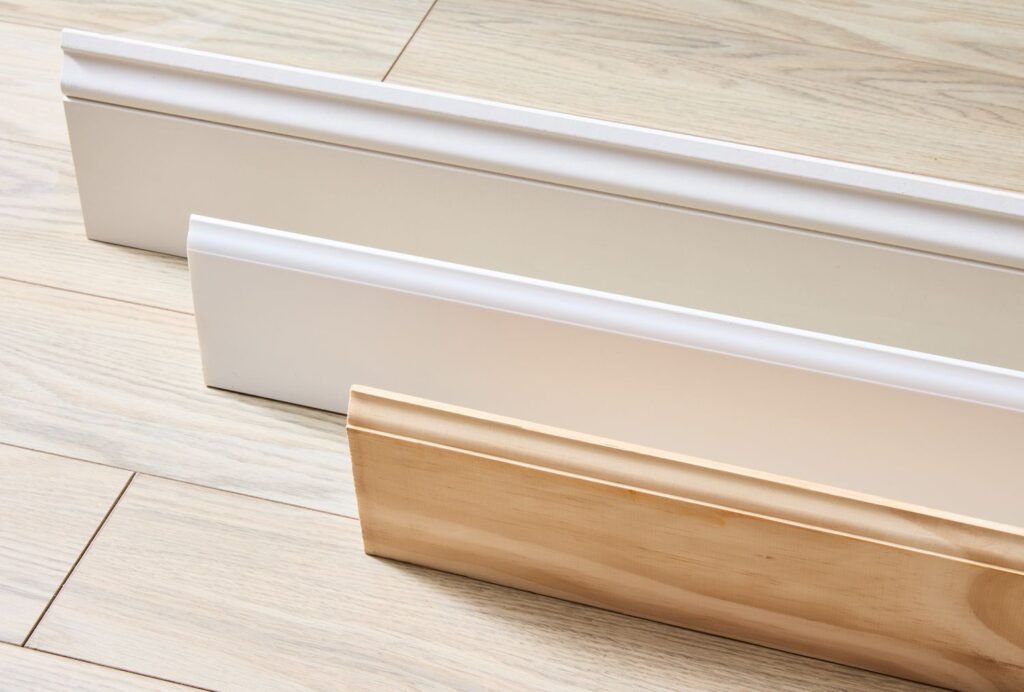
Builders often struggle to choose between MDF, finger-jointed pine (FJP), and PVC baseboards. Each material behaves differently during installation and over time. Selecting the wrong option can lead to swelling, nail pops, or costly callbacks—especially in humid or high-traffic environments.
The best baseboard material depends on the installation environment. MDF baseboards are cost-effective and stable for painted trim in dry interiors. Finger-jointed pine (FJP) provides better durability and nail-holding strength, making it suitable for high-traffic residential areas. PVC baseboards are completely moisture-resistant and ideal for bathrooms, basements, and humid climates. Builders typically choose between these materials based on moisture exposure, durability requirements, and long-term maintenance expectations.
To help builders make the right choice, let’s compare MDF, FJP, and PVC baseboards based on installation performance, durability, cost, and real project experience.
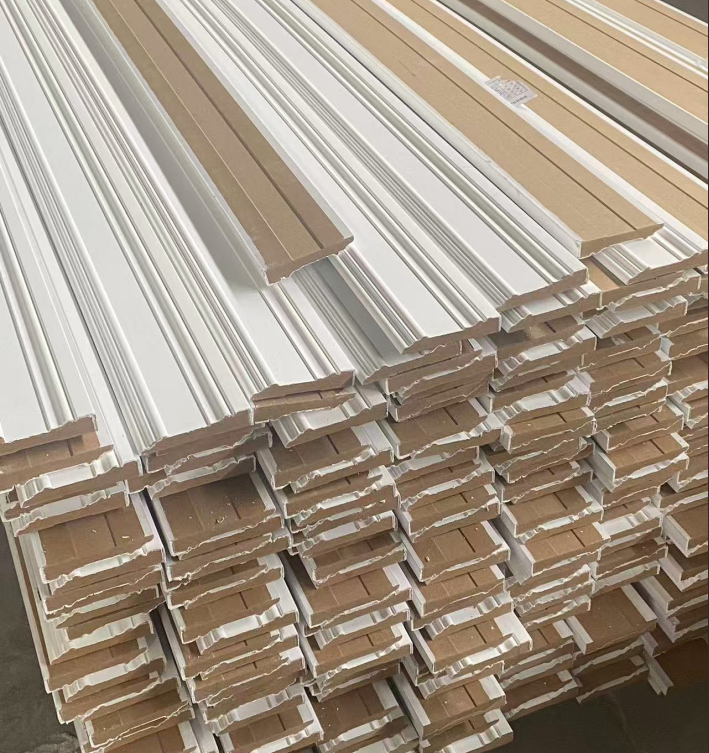
What Is MDF Baseboard and When Should Builders Use It?
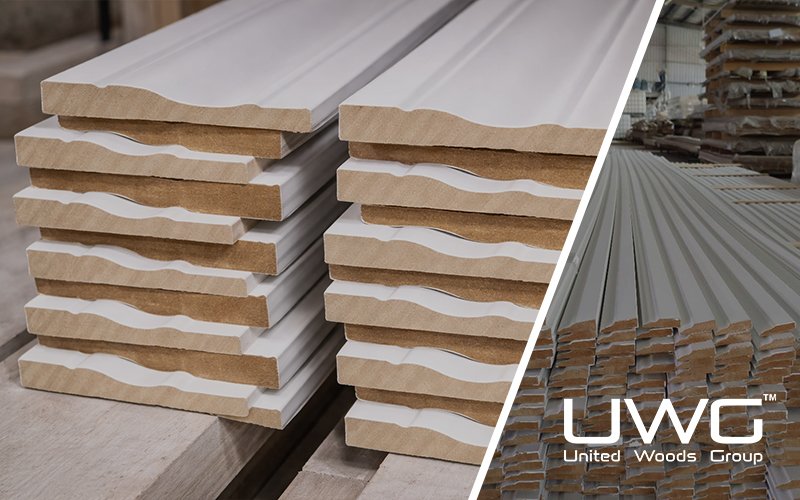
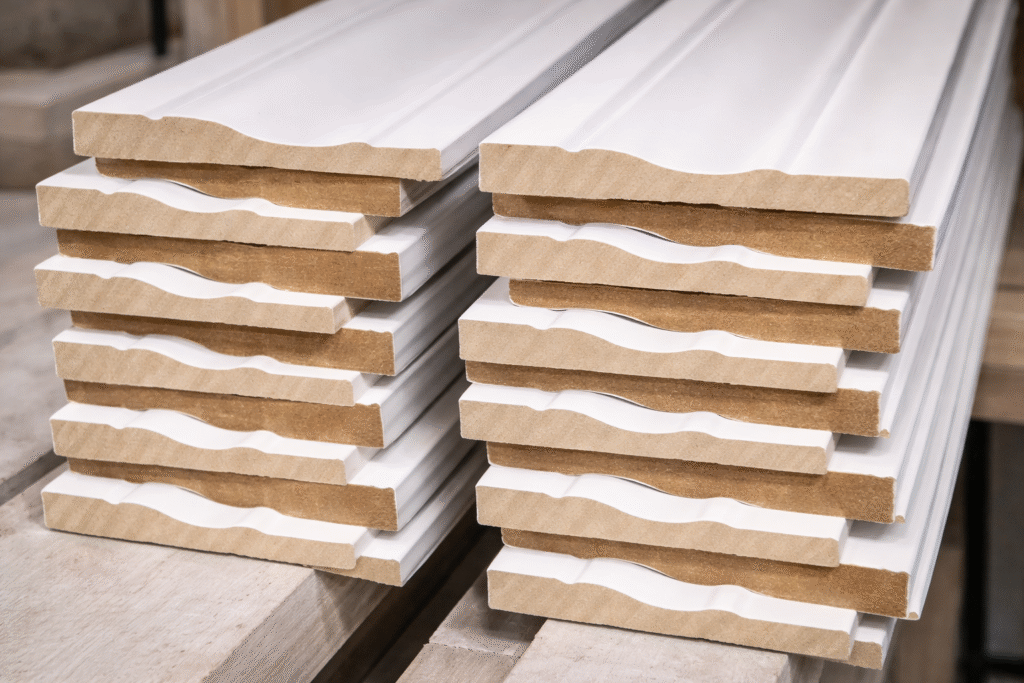
Medium Density Fiberboard (MDF) is an engineered wood product made by compressing wood fibers with resin under high pressure. Because the material is uniform and smooth, MDF baseboards are widely used in paint-grade trim applications.
In many residential developments, builders choose MDF because it provides a consistent surface that accepts primer and paint extremely well. Most MDF baseboards sold in North America come pre-primed, which helps speed up finishing during installation.
From our experience working on interior projects, MDF can be very efficient for large-scale installations. For example, during a multi-unit apartment renovation project, we used MDF baseboards across more than 60 units. The material allowed painters to achieve a very consistent finish with minimal sanding.
However, MDF does have limitations:
- It absorbs moisture easily if exposed to water.
- Nail holes can sometimes pucker slightly if the material is not properly set or filled.
- Edges may swell if installed in damp areas.
Because of these characteristics, MDF works best in dry interior environments such as living rooms, bedrooms, and hallways.
According to building material guides such as those referenced by The Spruce, MDF is often chosen when budget and paint finish consistency are the primary priorities.
What Is Finger-Jointed Pine (FJP) Baseboard?
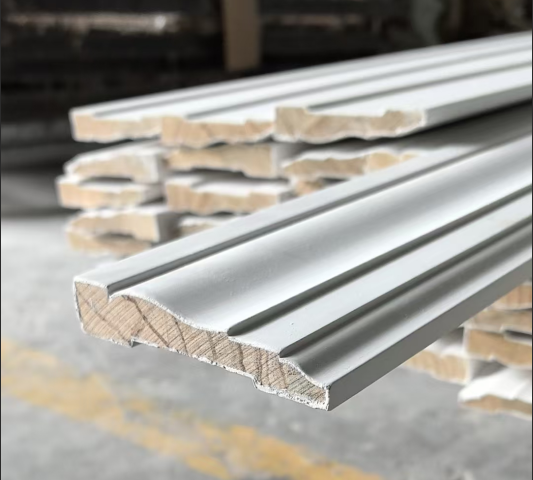
Finger-jointed pine (often abbreviated as FJP) is a type of engineered wood trim made by joining short pieces of pine together using interlocking “finger” joints. These joints are glued and pressed to create longer, stable boards.
Builders frequently ask: What is finger jointed baseboard and why is it so common in new homes?
The answer is simple. FJP offers many of the benefits of natural wood while reducing cost and material waste. Because it is made from smaller wood segments, manufacturers can produce long, straight boards that are less likely to warp.
In real construction projects, FJP baseboards tend to perform well during installation.
For example, in several custom home interior trim installations, carpenters often prefer finger-jointed pine over MDF for one key reason: nail holding strength. When using finish nailers, FJP compresses around the nail head more naturally than MDF, which can reduce visible imperfections.
Other advantages include:
- Better impact resistance than MDF
- Easier nail setting and filling
- More durable edges during installation
However, FJP is still wood, which means it can respond to environmental changes.
Possible disadvantages include:
- Visible joints in some lower-quality boards
- Slight expansion or contraction with humidity
- Slightly higher cost than MDF.
Despite these factors, many contractors consider FJP a balanced option between cost and durability, especially for residential interior trim.
Are PVC Baseboards Worth It for Modern Construction?
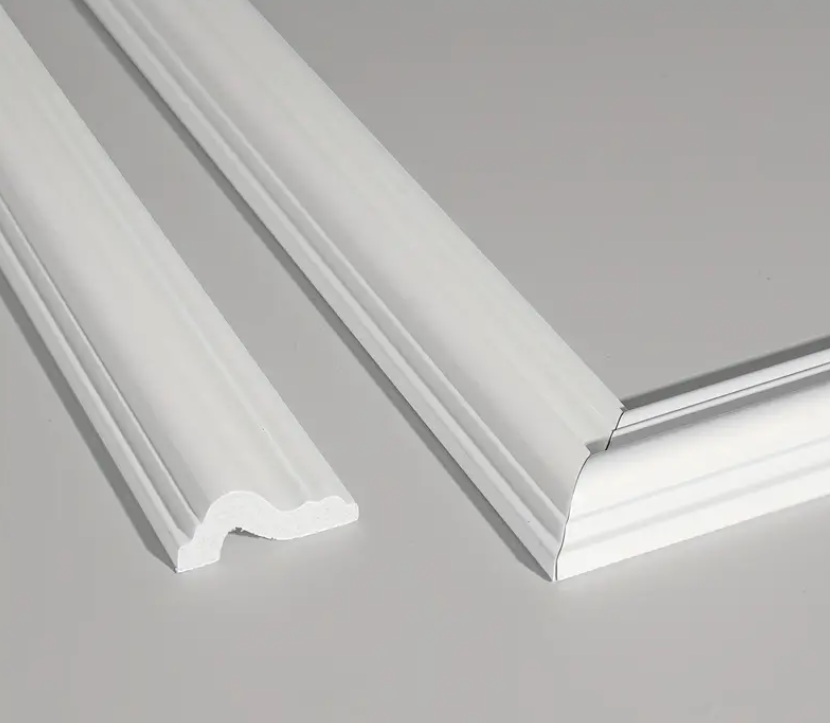
PVC baseboards are manufactured from polyvinyl chloride plastic, a synthetic material widely used in building products such as pipes, siding, and exterior trim.
The main advantage of PVC baseboards is simple: they are completely waterproof.
Unlike MDF or wood products, PVC does not absorb moisture. It will not rot, swell, split, or warp when exposed to water. Because of this property, PVC trim is often used in areas where traditional wood products struggle.
Typical applications include:
- Bathrooms
- Laundry rooms
- Basements
- Coastal homes
- Commercial buildings with frequent cleaning.
In several renovation projects in humid coastal environments, builders found that switching from MDF trim to PVC baseboards significantly reduced maintenance issues. After two years of seasonal humidity changes, the PVC trim showed no swelling or edge deterioration.
Another benefit is durability. PVC is resistant to insects and mold, which can be a concern in damp environments.
However, builders should also consider a few trade-offs:
- Material cost is usually higher than MDF and FJP.
- Some installers find PVC slightly more flexible during installation.
- Expansion gaps may be necessary in longer runs depending on manufacturer guidelines.
Despite these considerations, PVC baseboards are increasingly popular in modern moisture-prone environments.
MDF vs FJP vs PVC Baseboards: Key Differences
For builders comparing trim materials, it helps to look at the key performance differences side by side.
| Material | Moisture Resistance | Durability | Cost | Installation | Best Applications |
|---|---|---|---|---|---|
| MDF | Low | Moderate | Low | Easy but edges can swell | Dry interior rooms |
| Finger-Jointed Pine (FJP) | Medium | High | Medium | Excellent nail holding | Living rooms, hallways |
| PVC | Excellent | High | Higher | Lightweight but flexible | Bathrooms, basements, humid climates |
In general:
- MDF is the most budget-friendly option. – FJP offers stronger durability and better installation performance. – PVC provides the best moisture protection.
Choosing the right material often depends on environmental exposure and project budget.
Technical Performance Comparison of Baseboard Materials
From a builder’s perspective, comparing baseboard materials goes beyond appearance. Performance factors such as moisture resistance, dimensional stability, nail holding strength, and finishing compatibility directly affect installation quality and long-term durability.
The table below summarizes the key technical properties of MDF, finger-jointed pine (FJP), and PVC baseboards based on commonly reported building material characteristics.
| Property | MDF Baseboard | Finger-Jointed Pine (FJP) | PVC Baseboard |
|---|---|---|---|
| Water Absorption | High – absorbs moisture easily if unsealed | Moderate – natural wood absorbs moisture but slower than MDF | Extremely low – waterproof |
| Dimensional Stability | Good in dry environments | Moderate – may expand or contract with humidity | Excellent – minimal expansion or warping |
| Swelling Risk | High in humid areas | Moderate | Very low |
| Nail Holding Strength | Moderate | High | Moderate |
| Impact Resistance | Moderate | High | High |
| Surface Finish Compatibility | Excellent for paint | Good for paint or stain | Good for paint |
| Maintenance Requirement | Moderate | Moderate | Very low |
| Expected Service Life | 10–15 years in dry interiors | 15–25 years depending on environment | 25+ years in most environments |
From an installation perspective:
- MDF provides the smoothest paint surface, which is why many production builders use it in large residential developments.
- FJP offers stronger nail retention and impact resistance, making it suitable for high-traffic areas.
- PVC provides the best dimensional stability in wet environments, making it ideal for bathrooms, basements, and coastal homes.
Cost Comparison: MDF vs FJP vs PVC Baseboards
Budget considerations are another important factor when choosing trim materials, especially for large residential or multifamily projects.
According to building supply estimates referenced by construction material suppliers and industry reports (such as NAHB cost surveys), baseboard material costs typically follow this pattern.
| Material | Average Material Cost (per linear foot) | Installation Difficulty | Typical Project Use |
|---|---|---|---|
| MDF | $1 – $2 | Easy | Large residential developments |
| Finger-Jointed Pine | $2 – $3 | Moderate | Mid-range homes |
| PVC | $3 – $5 | Moderate | Moisture-prone environments |
However, experienced builders often consider lifecycle cost instead of only material price.
For example:
- MDF may require replacement if exposed to moisture damage.
- FJP may require more finishing work to hide joints.
- PVC has higher upfront cost but minimal long-term maintenance.
In renovation projects or rental properties where moisture exposure is common, many contractors find that PVC baseboards reduce maintenance calls over time.
Real Project Cases: Choosing the Right Baseboard Material
To better understand how these materials perform in real construction scenarios, consider the following examples based on typical builder experiences.
Case 1: Apartment Renovation Project
During a large apartment renovation, the builder needed a cost-effective trim solution across more than 50 units.
The team selected MDF baseboards because they were pre-primed and easy to paint. Installation moved quickly, and the smooth surface allowed painters to achieve a consistent finish throughout the property.
However, installers avoided using MDF in laundry areas and instead used moisture-resistant alternatives.
Case 2: Coastal Residential Construction
In a coastal housing project with consistently high humidity levels, early test installations using MDF experienced minor swelling along baseboard edges.
The builder replaced the trim with PVC baseboards in bathrooms and ground-floor areas. After multiple seasons, the PVC trim remained stable without visible expansion or deterioration.
This change significantly reduced post-construction maintenance calls.
Case 3: Custom Home Interior Trim
For a custom home with detailed interior trim work, the builder selected finger-jointed pine baseboards.
Carpenters preferred FJP because it held nails securely and resisted dents during installation. The material also provided a more solid feel compared with MDF.
Although slightly more expensive, the builder considered FJP the best balance between durability and cost for premium interior spaces.
Frequently Asked Questions About Baseboard Materials
Q: What is MDF baseboard and when should builders use it?
A: Medium Density Fiberboard (MDF) is a cost-effective engineered wood product that provides a perfectly smooth surface for painted trim. It is best used in dry interior environments, such as living rooms and bedrooms, where budget and paint finish consistency are the primary priorities.
Q: What is Finger-Jointed Pine (FJP) baseboard?
A: Finger-jointed pine (FJP) is an engineered wood trim made by joining short pieces of pine together. It offers better impact resistance and superior nail-holding strength compared to MDF, making it a highly durable option for high-traffic residential areas.
Q: When are PVC baseboards the best choice for a project?
A: The main advantage of PVC baseboards is that they are completely waterproof. Because they will not rot, swell, or warp when exposed to water, PVC trim is the ideal choice for bathrooms, basements, laundry rooms, and highly humid climates.
Q: How do I choose between MDF, FJP, and PVC baseboards?
A: Builders should choose based on the installation environment. Use MDF for cost-effective, dry-area painted trim; use FJP for areas requiring higher durability and better nail-holding strength; and use PVC exclusively for areas with high moisture exposure to prevent long-term failure.
Summary
Each baseboard material has strengths. MDF offers affordability and smooth paint finishes, finger-jointed pine provides stronger durability and easier installation, and PVC delivers superior moisture resistance. For builders, the best choice depends on environment, traffic levels, and long-term maintenance considerations.