Introduction
Imagine you’re a builder preparing to install barn doors for a new residential project. The client wants a modern farmhouse look — sliding doors for the kitchen pantry, a wider set for the living room, and compact options for bathrooms. When you start measuring, you realize that each opening is slightly different, and standard door kits don’t always match the available space. Choosing the wrong size could mean gaps, track issues, or wasted materials.
So, what exactly should builders and wholesalers know about barn door sizes? The key is to balance standardization and flexibility. Most projects rely on common sizes such as 36”×84” or 42”×96”, which fit typical interior openings and simplify installation. Yet, in modern architecture and renovation work, custom dimensions are often required to accommodate oversized openings, unique wall structures, or design-driven proportions. Material choice and track capacity also play a crucial role — a large solid-wood door, for example, demands stronger hardware and additional wall clearance. For wholesalers, focusing on high-demand standard sizes while offering modular customization options helps control inventory, reduce costs, and meet diverse project needs. In short, understanding how barn door sizing affects both installation precision and logistical efficiency is the foundation for success in this growing market.
Standard Barn Door Sizes and Their Applications
When it comes to barn doors, there’s no one-size-fits-all solution — but the industry has developed several standard dimensions that cover most residential and light commercial needs. Understanding these standards is essential for builders who need predictable installation results and wholesalers who plan product assortments efficiently.
Common Standard Sizes
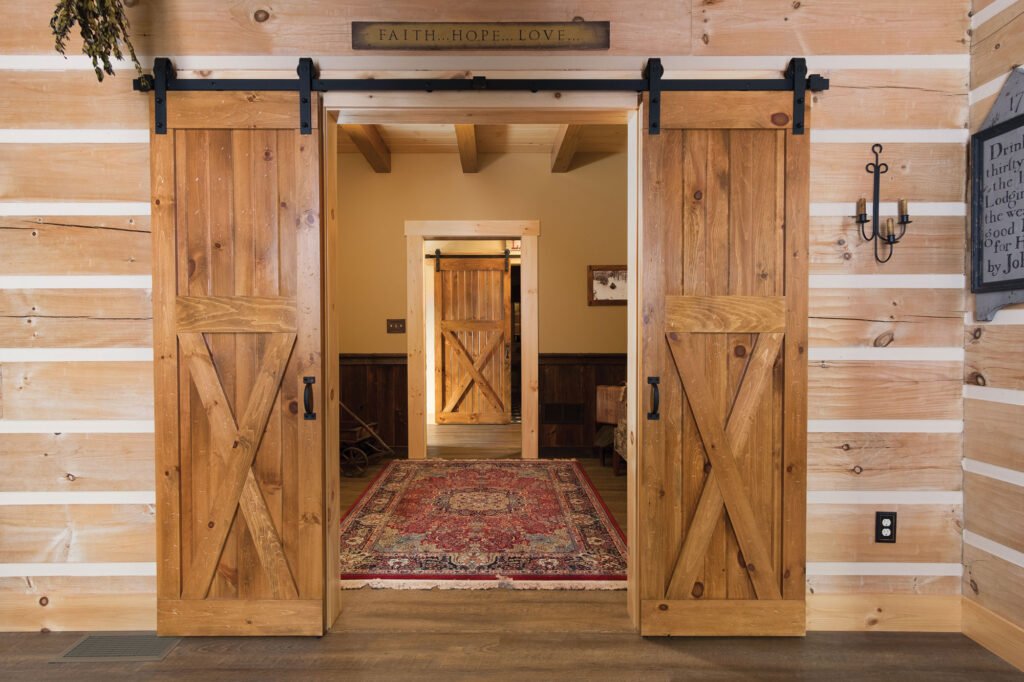
Most single barn doors are available in widths ranging from 30 inches to 42 inches (762–1067 mm), with 36 inches (914 mm) being the most popular for interior use. Heights typically fall between 80 inches and 96 inches (2032–2438 mm), matching standard door openings in modern construction. For wider entrances, double barn doors (two panels that slide open from the center) are often used. Common combinations include 2×36”, 2×42”, or 2×48” panels, depending on the opening width and the desired overlap for full coverage.
Application Scenarios
- Residential Homes: Standard 36”×84” barn doors are ideal for bedrooms, closets, and bathrooms. They provide adequate clearance while maintaining proportional aesthetics with most room openings.
- Commercial or Public Spaces: Taller and wider options — such as 42”×96” — are often used in offices, restaurants, or retail projects to meet accessibility and design requirements.
- Pantry, Laundry, and Utility Areas: Narrower doors, such as 30”×80”, are common in secondary spaces where compact functionality matters more than grand appearance.
The Importance of Clearance and Overlap
Unlike hinged doors, sliding barn doors require extra width beyond the opening size. Builders should allow at least 2 inches (50 mm) of overlap on each side to ensure full coverage and privacy. The door track length should also be at least twice the door width, providing enough travel distance for smooth sliding.
By following these size conventions, builders can streamline installations, while wholesalers can stock the most in-demand dimensions — reducing customization costs and improving order turnover.
Custom Barn Door Options and How to Choose
While standard sizes cover most installations, many builders and wholesalers encounter projects where custom barn door dimensions become necessary. These situations often arise due to non-standard wall openings, architectural design preferences, or aesthetic requirements that demand a unique proportion or finish.
When Custom Sizes Are Needed
- Oversized Openings: In modern open-concept homes or commercial venues, doorways may exceed 48 inches in width or 96 inches in height. Custom doors can be made up to 60”×108” or even larger, depending on material stability and track capacity.
- Unusual Wall Structures: Older buildings or remodel projects often have uneven openings or limited wall space beside the frame, making standard kits unsuitable. Custom sizing ensures the door fully covers the opening without blocking nearby fixtures.
- Design Intent: Sometimes, customization is not about necessity but style — for example, choosing a taller door to create a sense of height, or a wider one to emphasize symmetry in double-door setups.
Materials and Structural Considerations
When ordering custom sizes, material choice directly affects performance:
- MDF or engineered wood works best for painted finishes and offers stability in larger sizes.
- Solid wood provides a premium look but may warp if dimensions exceed 96 inches without proper reinforcement.
- Glass or mixed-material doors (wood + frosted glass) require precise balancing to prevent excessive weight on the track.
Builders should verify the track system’s load-bearing capacity and wall anchoring strength when specifying large custom doors.
How Wholesalers Can Manage Custom Orders Efficiently
For wholesalers, customization brings both opportunity and complexity. Maintaining a modular production approach — for example, keeping a base inventory of standard-size frames and adjustable top rails — allows faster fulfillment of special orders. Additionally, offering custom-size options within set increments (e.g., every 2 inches) can simplify pricing and minimize production waste.
Custom barn doors not only enhance flexibility for builders but also help wholesalers differentiate their product lines — catering to high-end or design-focused clients seeking tailored solutions.

Sizing Tips for Builders and Wholesalers
Getting barn door sizes right isn’t just about matching measurements — it’s about ensuring the entire system functions smoothly, from installation to long-term use. The following tips can help both builders and wholesalers minimize costly mistakes and maintain consistent quality across projects.
Measure Openings Accurately
Before ordering, builders should measure the width and height of the finished opening, not the rough frame. For sliding systems, allow for an additional 2–4 inches of door width to achieve full coverage and privacy. Also, ensure there’s enough wall space beside the opening for the door to slide completely open without obstruction.
Check Clearance and Track Placement
A barn door requires both vertical and horizontal clearance:
- Vertical clearance: At least 6–8 inches above the opening for the track and hardware.
- Horizontal clearance: Wall space equal to at least twice the door width. Builders should also confirm that electrical switches, trims, or baseboards won’t interfere with the door’s sliding path.
Standardize Orders for Efficiency
For wholesalers or large construction projects, keeping to a few key size groups — such as 30”, 36”, 42” widths and 84”, 96” heights — simplifies packaging, storage, and transport. It also helps control costs, since accessories (tracks, rollers, handles) can be stocked in matching configurations.
Factor in Installation and Logistics
A common oversight is not accounting for packaging and delivery. Oversized custom doors may exceed standard pallet dimensions or container heights, increasing freight costs. Wholesalers should coordinate with manufacturers on KD (knock-down) packaging or flat-packed prehung systems to improve container utilization.
Align with Market Demand
In the North American market, the 36”×84” barn door remains the most popular due to its fit with standard interior openings. Builders working on multi-unit housing or retail fit-outs should prioritize this size, while wholesalers can use it as the baseline for pricing and volume discounts.
By combining accurate sizing with standardized logistics and market awareness, both builders and wholesalers can reduce rework, lower costs, and deliver barn doors that fit perfectly — both structurally and commercially.
-1024x532.jpg)
Conclusion
Selecting the right barn door size is more than a matter of aesthetics — it’s a crucial step that determines installation accuracy, usability, and overall project efficiency. For builders, precise measurement and awareness of standard sizing ensure smoother on-site assembly and fewer costly adjustments. For wholesalers, maintaining a smart mix of standard and customizable options provides flexibility to meet diverse client demands while keeping inventory streamlined.
From understanding standard sizes like 36”×84” to planning for custom dimensions and clearance space, knowing what to expect allows you to make informed decisions at every stage — from design to delivery. Whether your goal is to enhance functionality in a single home renovation or to manage high-volume orders for a national retail program, the right approach to barn door sizing can make all the difference.
Ultimately, success in this category depends on combining technical precision with market insight — ensuring every door you supply or install not only fits the opening, but fits your business strategy as well.