
Introduction
A shipment has been approved, production is complete, and the material is ready to move. On paper, the pricing looks similar, but the delivery options are different: one quote ends at the port, the other goes all the way to the jobsite. For many builders, this choice is treated as a logistics detail—something to be handled after contracts are signed and schedules are set. Only later, when materials are delayed, storage becomes an issue, or crews are waiting, does the delivery method start to affect the project in very real ways.
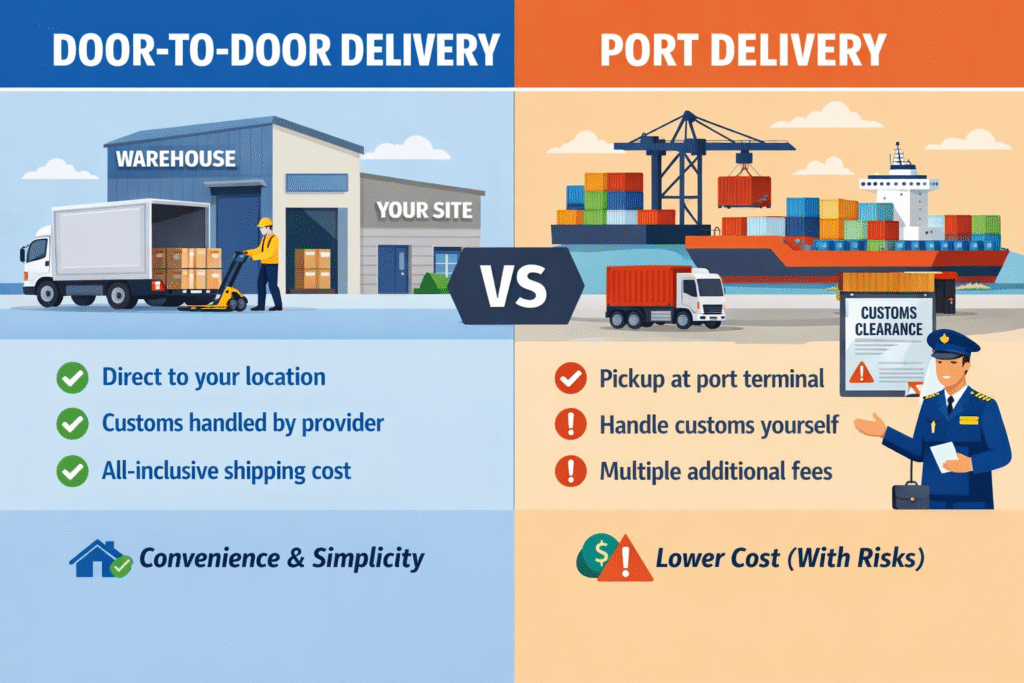
The difference between door-to-door delivery and port delivery is not just where the truck stops. It changes how costs are exposed, how risk is allocated, how schedules hold together, and who is responsible when problems arise. For builders, choosing the right delivery method is a project management decision that directly impacts budget control, labor planning, and execution certainty—not a shipping preference.
Cost Visibility and Risk Allocation
At first glance, port delivery often appears cheaper. The unit price looks lower, and the freight line item may seem easier to accept during estimating. However, what matters to builders is not the visible cost, but the total cost that lands on the project.
With port delivery, several costs sit outside the original quote: inland trucking, port handling, demurrage, storage, and coordination fees. These expenses may be handled by different parties and invoiced at different times, making them harder to track and easier to underestimate. For projects with tight margins or fixed pricing, these “external” costs can quietly erode profitability.
Door-to-door delivery consolidates more of these variables into a single scope. While the upfront price may be higher, the cost structure is clearer. Builders know earlier what the landed cost will be and where financial responsibility sits. This predictability is especially valuable for fixed-price or GMP projects, where unplanned logistics costs cannot easily be passed downstream.
Risk allocation also shifts. With port delivery, builders often assume more exposure by default—delays, extra fees, and coordination issues become their problem to solve. Door-to-door delivery typically transfers more of that risk upstream, reducing the number of cost surprises that surface after materials have already shipped.

Scheduling, Labor, and Jobsite Impact
From a scheduling standpoint, arrival at port does not mean materials are ready for installation. Port delivery introduces additional steps between material arrival and jobsite availability, each with its own dependencies.
Builders using port delivery must coordinate customs clearance, arrange inland transport, manage delivery windows, and often secure temporary storage. Any disruption—port congestion, trucking delays, or warehouse availability—can push material availability beyond planned dates. These delays ripple outward, affecting labor sequencing, inspections, and downstream trades.
Door-to-door delivery simplifies this chain. Materials are scheduled to arrive closer to when and where they are needed. This alignment reduces the gap between delivery and installation, which is critical on projects with limited storage space or tight site logistics, such as urban or multi-family builds.
Labor efficiency is also affected. Crews scheduled for installation assume materials will be on site and ready. When deliveries are delayed or arrive incomplete due to coordination issues, labor costs increase even if material costs do not. From a builder’s perspective, lost labor time often outweighs modest differences in freight pricing.
In practice, door-to-door delivery supports tighter schedules, while port delivery requires more buffer time and active management to avoid disruptions.
Responsibility, Communication, and Problem Resolution
When something goes wrong, the delivery method determines how quickly issues can be identified and resolved.
With port delivery, responsibility is fragmented. Different parties handle manufacturing, ocean freight, customs clearance, inland transport, and final delivery. When delays, damage, or documentation issues occur, builders may find themselves coordinating between multiple stakeholders, each responsible for a small piece but none accountable for the outcome as a whole.
This fragmentation also complicates communication. Information may arrive late or incomplete, leaving builders reacting instead of planning. In many cases, the jobsite is the last to know there is a problem, even though the consequences land there first.
Door-to-door delivery simplifies responsibility. Fewer handoffs mean fewer points of failure. When issues arise, builders have a clearer escalation path and faster resolution because accountability is more centralized. This does not eliminate risk, but it reduces the time and effort required to manage it.
For builders managing multiple projects simultaneously, this clarity can make a meaningful difference. Less time spent chasing updates and coordinating fixes translates directly into better focus on construction execution.
Conclusion
For builders, the choice between door-to-door delivery and port delivery is not a logistics afterthought—it is a project decision with real financial and operational consequences. Port delivery can make sense for teams with strong logistics infrastructure, available storage, and the capacity to manage added complexity. Door-to-door delivery, while sometimes carrying a higher upfront cost, offers clearer cost visibility, more predictable scheduling, and simplified responsibility.
The right choice depends on project scale, timeline sensitivity, and internal resources. Builders who evaluate delivery methods through the lens of total project impact—rather than freight cost alone—are better positioned to protect schedules, control budgets, and reduce execution risk.
Articles that you may be interested in:
Door-to-Door Delivery Process Explained Step by Step