
Molded interior doors are widely used in residential construction across the United States because of their cost efficiency, consistent quality, and large-scale manufacturing capability. Builders and interior door wholesalers rely on these doors for standardized sizing and reliable supply. However, many professionals are unfamiliar with how molded doors are produced in modern factories. Understanding the manufacturing process can help buyers better evaluate product quality and suppliers—but how exactly are molded interior doors manufactured?
Molded interior doors are produced through a structured manufacturing process that combines molded door skins, engineered core materials, and a wooden frame system. The process typically includes skin molding, core preparation, frame assembly, hot pressing, trimming, and finishing. Through automated production lines and controlled pressing technology, manufacturers can produce lightweight, durable, and cost-effective interior doors at large scale for residential construction.
1. Materials Used in Molded Interior Doors
The production of molded interior doors relies on a combination of engineered wood materials and structural components designed to provide stability, durability, and manufacturing efficiency.
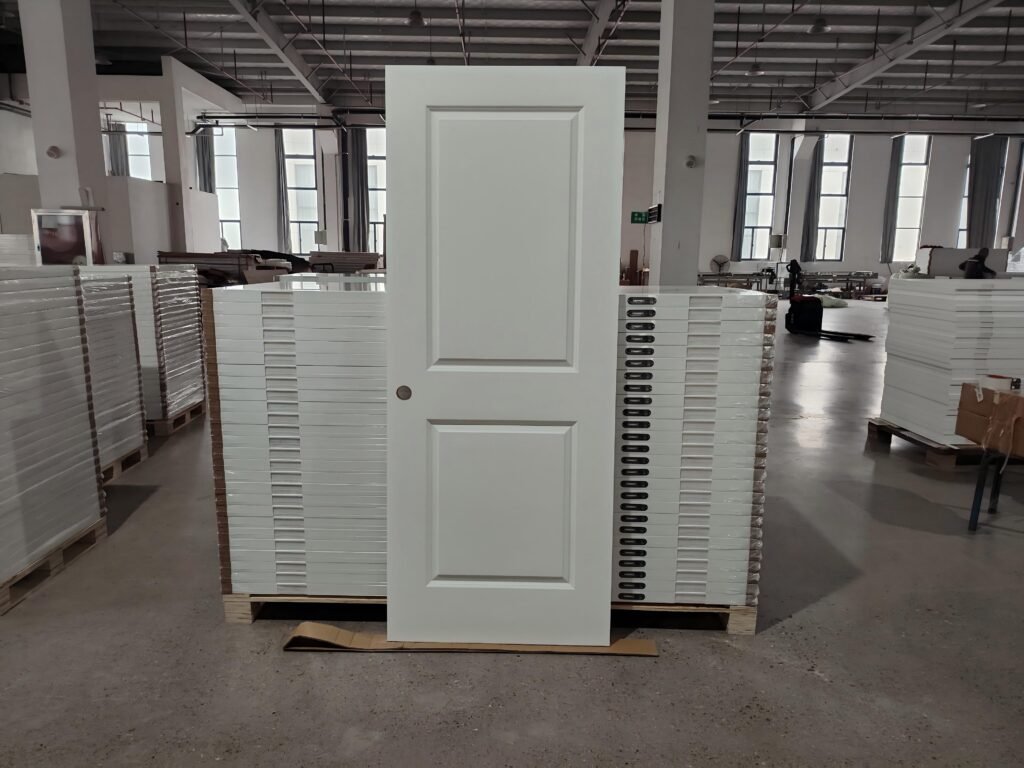
According to industry manufacturing guidelines referenced by companies such as Woodgrain Millwork and Reeb Learning Center, molded interior doors are typically composed of four primary elements:
- Molded door skins
- Internal core structure
- Wooden framing components (stiles and rails)
- Industrial adhesives and bonding resins
These materials work together to form a lightweight yet structurally stable composite door system widely used in residential construction.
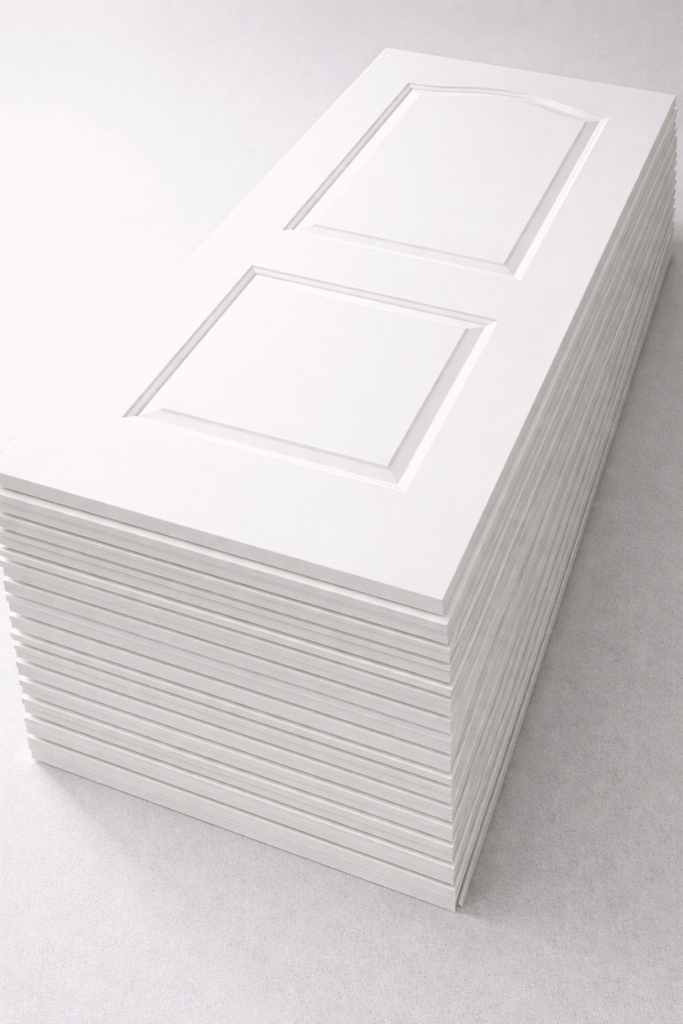
1.1 Molded Door Skins
The outer surface of molded interior doors is typically made from high-density fiberboard (HDF). HDF is produced by compressing refined wood fibers with synthetic resins under high pressure and temperature, creating a dense and uniform panel material suitable for molding decorative door patterns.
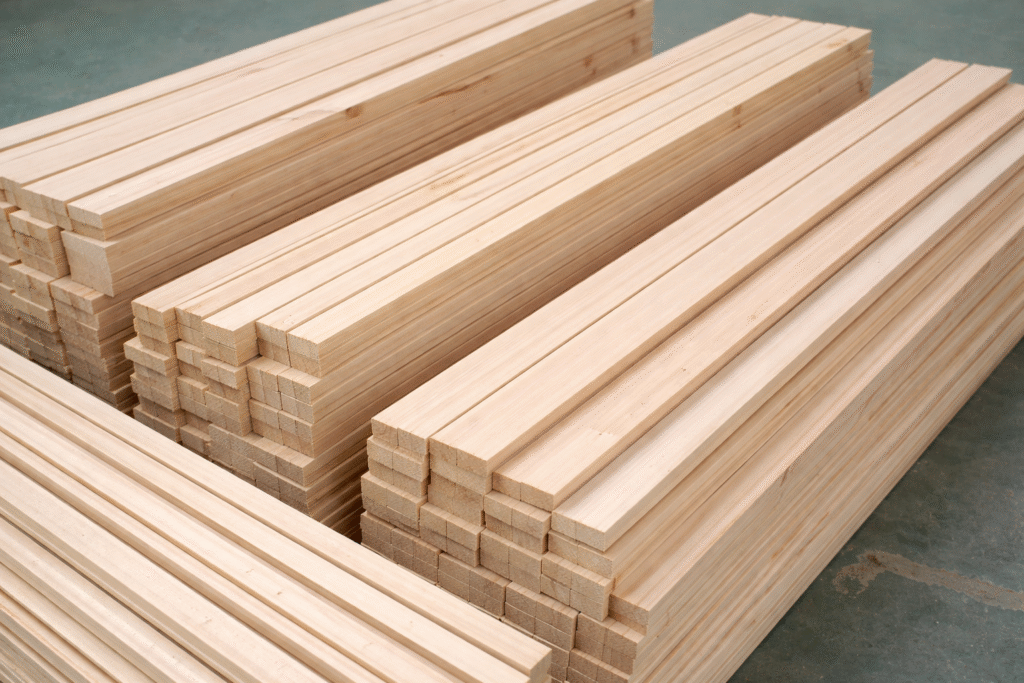
1.2 Stiles and Rails
The structural frame of the door is formed by vertical stiles and horizontal rails, usually manufactured from finger-jointed pine or engineered wood lumber. These components provide structural rigidity and maintain the dimensional stability of the door panel.
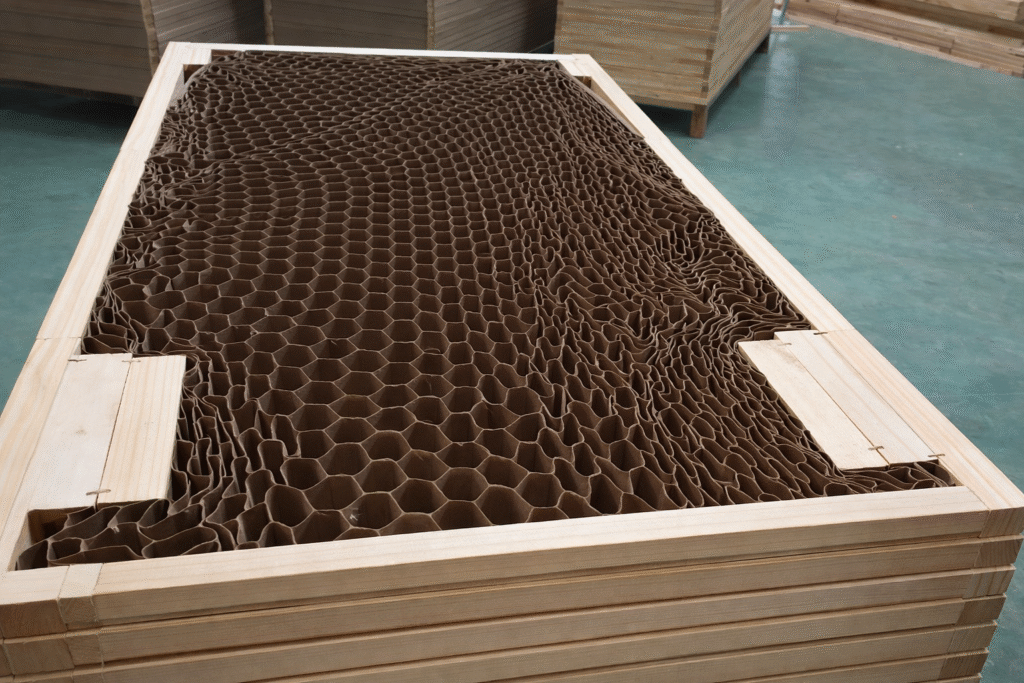
1.3 Door Core Materials
The interior portion of the door is filled with a core structure, typically either honeycomb paper or engineered wood panels, which helps support the door skins and maintain the door’s shape during use.
1.4 Adhesives and Bonding Resins
Industrial adhesives are used to bond the door skins, frame components, and core materials together during the pressing stage of manufacturing. These bonding systems ensure the structural integrity of the finished door.
1.5 Key Materials and Their Functions
| Door Component | Typical Material | Function in Door Structure |
|---|---|---|
| Door skins | High-density fiberboard (HDF) | Forms the decorative door surface and molded panel design |
| Frame (stiles & rails) | Finger-jointed pine or engineered lumber | Provides structural support and maintains door alignment |
| Core structure | Honeycomb kraft paper or engineered wood core | Supports door skins and controls door weight and stability |
| Adhesive system | Industrial bonding resins (UF, PVA, etc.) | Bonds all components into a single integrated door structure |
2. Step 1: Preparing the Molded Door Skins
The manufacturing process begins with the production of molded door skins, which form the decorative outer surface of the door.
Wood fibers are refined from wood chips and combined with binding resins to produce high-density fiberboard sheets. These sheets are then placed into hydraulic molds that press the desired panel design into the material.
Under controlled heat and pressure, the molds permanently form the door panel pattern. The molded skins are then cooled and trimmed to standardized sizes before moving to the assembly stage.
3. Step 2: Manufacturing the Door Core
After the molded door skins are produced, manufacturers prepare the internal core that will be installed between the two door skins. The core provides structural support and helps maintain the overall shape of the door during use.
For hollow-core molded doors, the most common core structure is a kraft paper honeycomb core. The honeycomb material is manufactured by expanding layers of kraft paper into a hexagonal cellular structure. This structure is then cut to match the internal dimensions of the door panel.
Once prepared, the honeycomb core is placed inside the door frame area between the stiles and rails. The lightweight cellular structure distributes pressure evenly across the door surface during the pressing stage.
For solid-core molded doors, manufacturers instead use engineered wood panels such as particleboard or composite fiberboard. These panels are cut to the required door size and inserted into the frame structure before the door skins are applied.
After the core material is positioned, the door assembly moves to the next stage where the skins, frame, and core are bonded together through high-pressure pressing.
4. Step 3: Building the Door Frame
After the core is prepared, manufacturers assemble the wooden frame that forms the perimeter structure of the door.
The frame is typically composed of four main components:
- two vertical stiles
- two horizontal rails
These frame members are cut to precise dimensions and positioned around the core structure. The stiles and rails are then assembled to create the structural skeleton of the door panel.
Once the frame is assembled, the core material is placed inside the frame area. This framed structure prepares the door for the next stage, where the molded skins are bonded to both sides of the assembly during the hot-press process.
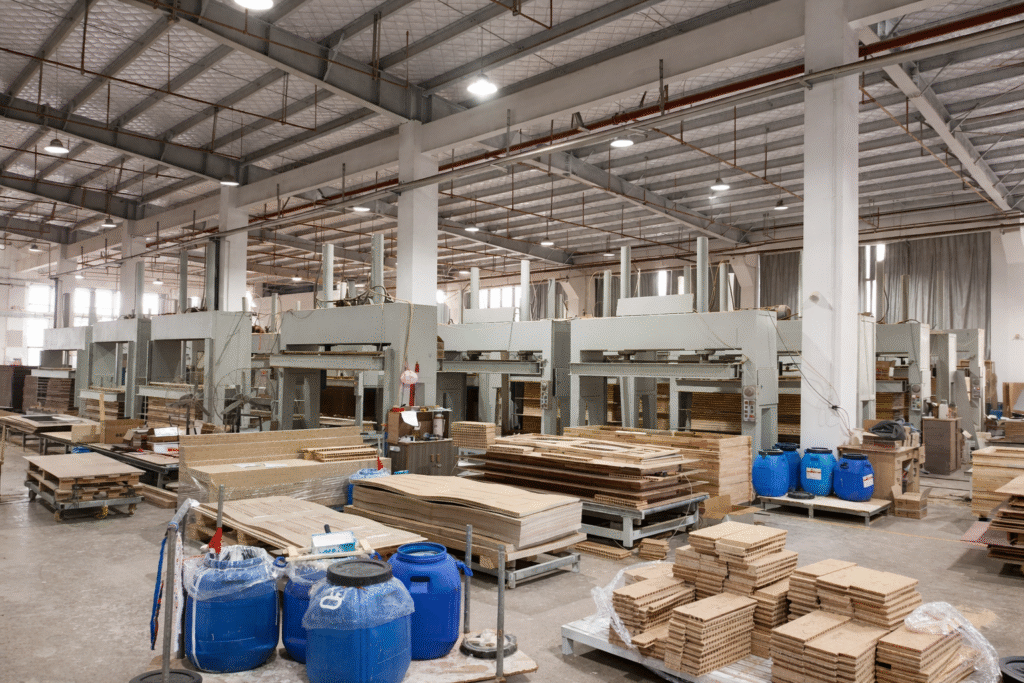
5. Step 4: Door Assembly and Hot Pressing
After the door skins, frame components, and core materials are prepared, the door enters the main assembly stage.
During assembly, the components are arranged in layers. A molded door skin is first placed on the press table, followed by the internal core and the assembled stile-and-rail frame. A second molded skin is then positioned on top of the structure.
Industrial adhesives are applied to the bonding surfaces to ensure proper adhesion between the skins, frame, and core materials.
Once the door assembly is prepared, it is transferred into a hydraulic hot press. The press applies controlled heat and pressure to bond all components into a single integrated door panel.
Typical hot pressing parameters in molded door manufacturing include:
| Process Parameter | Typical Range |
|---|---|
| Press temperature | 150–180 °C |
| Press pressure | 2–4 MPa |
| Press time | 2–5 minutes |
Under these conditions, the adhesive cures and permanently bonds the molded skins, frame, and core structure together.
After pressing, the door panels are removed from the press and allowed to cool before moving to the trimming and finishing stage.
6. Step 5: Trimming, Sanding, and Surface Preparation
After the hot pressing stage, the bonded door panels move to the finishing line for dimensional trimming and surface preparation.
First, automated cutting equipment trims the door panels to their final dimensions and shapes the edges. The panels then pass through sanding machines that smooth the surface and remove any minor imperfections created during molding or pressing.
Finally, the doors are cleaned and prepared for primer coating or other finishing treatments before moving to the final inspection stage.
7. Step 6: Finishing and Quality Inspection
In the final manufacturing stage, the doors receive finishing treatments and undergo quality inspection.
Many molded interior doors are factory-primed to prepare the surface for painting. After finishing, each door is inspected to ensure proper panel alignment, surface quality, and dimensional accuracy.
Doors that meet quality standards are then packaged and prepared for shipment to distributors, wholesalers, and construction suppliers.
8. Why Molded Doors Are Popular in Residential Construction
Molded interior doors have become the dominant door type used in residential construction across the United States. According to industry sources such as the National Association of Home Builders (NAHB) and market research reports from Freedonia Group, molded doors account for a large share of interior door installations in new housing developments.
Their popularity is largely driven by manufacturing efficiency, cost advantages, and design consistency, making them particularly suitable for large-scale residential construction.
8.1 Cost Efficiency
Compared with solid wood doors, molded interior doors can be manufactured using engineered wood materials and automated production lines. This significantly reduces material costs and enables manufacturers to produce large volumes of doors at competitive prices.
For production home builders and multifamily housing projects, this cost efficiency makes molded doors an attractive option for interior door applications.
8.2 Consistent Design
Molded door skins are produced using precision steel molds, which ensures consistent panel designs and uniform dimensions across large production batches. This level of consistency is especially valuable for builders managing large housing developments where standardized components simplify installation and inventory management.
8.3 Lightweight Construction
Many molded interior doors use honeycomb core structures, which reduce door weight while maintaining sufficient structural stability. Lightweight doors are easier to transport, handle, and install on construction sites.
8.4 Scalable Manufacturing
Modern molded door factories operate highly automated production lines capable of producing thousands of door panels per day. This scalable manufacturing capability ensures a stable supply of interior doors for builders, distributors, and door wholesalers serving the residential construction market.
| Key Advantage | Description | Impact on Residential Construction |
|---|---|---|
| Cost efficiency | Engineered materials reduce manufacturing costs | Lower overall project cost |
| Consistent design | Molded skins ensure uniform panel patterns | Simplifies large housing projects |
| Lightweight structure | Honeycomb core reduces door weight | Easier installation for contractors |
| Scalable production | Automated manufacturing lines | Reliable supply for builders and wholesalers |
Frequently Asked Questions About Molded Door Manufacturing
Q: What materials are used to manufacture molded interior doors?
A: Molded interior doors are typically composed of four primary elements: molded high-density fiberboard (HDF) door skins, an internal core structure (such as honeycomb paper or engineered wood), wooden framing components (stiles and rails), and industrial bonding adhesives.
Q: How are molded door skins made?
A: Molded door skins are produced by compressing refined wood fibers and binding resins under high heat and pressure in hydraulic molds. This process permanently stamps the desired decorative panel pattern into the high-density fiberboard (HDF) sheet, creating a durable outer surface.
Q: What is the purpose of stiles and rails in a molded door?
A: Stiles (the vertical components) and rails (the horizontal components) form the structural wooden frame of the door. Usually manufactured from finger-jointed pine or engineered lumber, they provide structural rigidity, support the core, and maintain the dimensional stability of the door panel.
Q: What are the main steps in the molded door manufacturing process?
A: The step-by-step manufacturing process includes: skin molding (forming the HDF panels), core preparation (sizing the honeycomb or wood core), frame assembly (building the stiles and rails), hot pressing (bonding the skins, core, and frame together with industrial adhesives), and finally, edge trimming and finishing.
Conclusion
Molded interior doors are produced through a standardized manufacturing process that combines molded door skins, structural frames, and engineered core materials. From skin molding and core preparation to hot pressing and finishing, each stage is designed to ensure consistent quality and efficient large-scale production. Understanding this process helps builders and interior door wholesalers better evaluate product quality and select reliable suppliers for residential construction projects.