
Introduction
In a large-scale residential or multifamily project, door selection quickly becomes a systems-level decision rather than a simple product choice. Consider a 400-unit apartment development requiring an average of seven interior doors per unit. The total demand exceeds 2,800 openings. At this volume, even small differences in installation time, freight efficiency, or damage rates can significantly affect budget performance and construction timelines. Choosing between prehung and knock-down (KD) doors is not merely a packaging preference—it directly impacts labor allocation, container loading strategy, on-site workflow, and schedule predictability.
In practice, neither system is universally better for large-scale construction; the optimal choice depends on which cost driver dominates the project. Prehung doors are typically better for labor-expensive or schedule-sensitive developments because factory alignment and assembly reduce on-site labor and improve installation consistency across hundreds of openings. Knock-down (KD) doors, however, are often more suitable for freight-sensitive or import-driven projects, where higher container loading efficiency can significantly reduce transportation cost. In large-scale construction, the decision therefore comes down to a trade-off between labor efficiency and logistics efficiency.

Structural Differences Between Prehung and Knocked Down Doors: Door Systems Explained
The distinction between prehung and knock-down doors begins with how the door system is delivered to the job site.
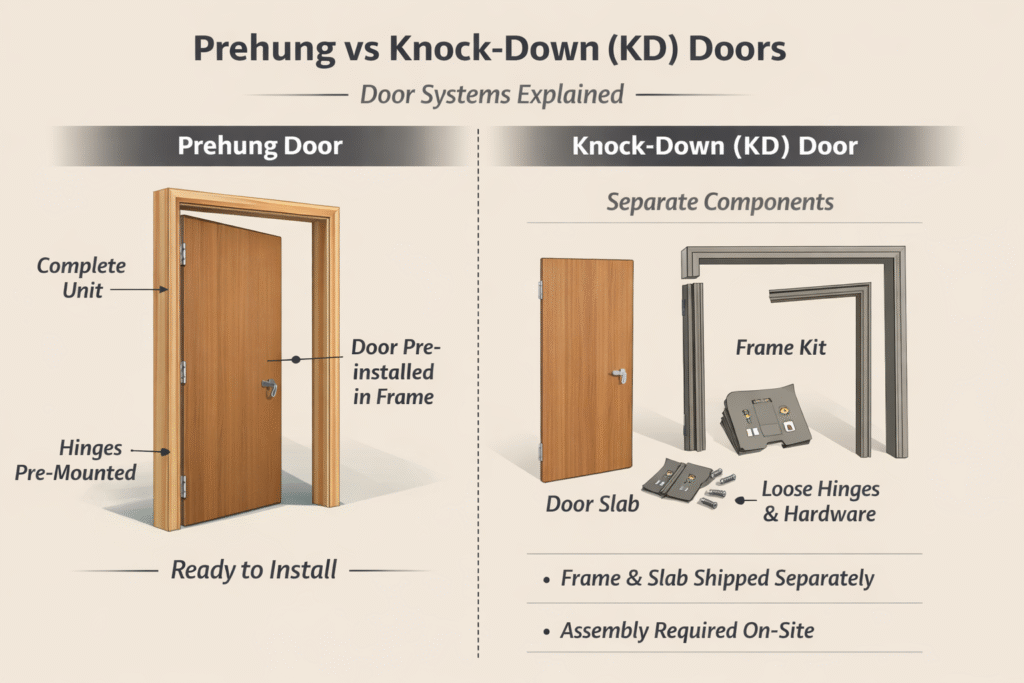
Prehung doors consist of a door slab factory-installed into its frame, with hinges pre-mounted and alignment completed prior to shipment. In many cases, casing may also be attached. The unit arrives ready to install as a single assembly, reducing the need for field fitting.
Knock-down (KD) doors are supplied with the slab and frame components packaged separately. The frame is assembled on-site, and hinges are installed during field preparation. This approach increases flexibility in packaging and transportation but shifts part of the assembly process to the construction site.
The fundamental difference lies in where alignment and assembly occur—at the factory or in the field.
Installation Efficiency Comparison
Labor productivity often becomes the decisive factor in large-scale projects.
Prehung doors streamline installation. Because hinges are pre-mounted and frames are squared at the factory, crews primarily focus on setting, shimming, leveling, and fastening the unit. Installation time per opening is typically shorter and more predictable. In North American residential projects, using prehung doors can reduce the average installation time per door from about 50 minutes to 35 minutes, making them particularly suitable for multifamily housing with repetitive layouts. Reduced adjustment work lowers reinstallation risk and supports tighter schedules.
KD doors require additional steps. Frames must be assembled, hinges positioned, and slab alignment verified on-site. While experienced crews can perform this process efficiently, it introduces more variability. Installation speed becomes dependent on labor skill level and workflow coordination.
In regions where skilled labor is limited or costly, prehung doors often provide measurable schedule stability.
| Factor | Prehung Doors | Knock-Down (KD) Doors |
| Delivery format | Door slab pre-installed in frame | Door slab and frame shipped separately |
| Factory preparation | Hinges installed and frame aligned at factory | Minimal factory assembly |
| On-site installation steps | Set unit → shim → level → fasten | Assemble frame → install hinges → hang slab → align |
| Average installation time | ~35 minutes per door | ~50 minutes per door |
| Labor skill requirement | Lower, process more standardized | Higher, depends on installer experience |
| Installation consistency | More predictable across large projects | Greater variability between crews |
| Best project scenario | Labor-expensive or schedule-driven developments | Projects with experienced crews and flexible timelines |
Factory Cost vs Field Cost
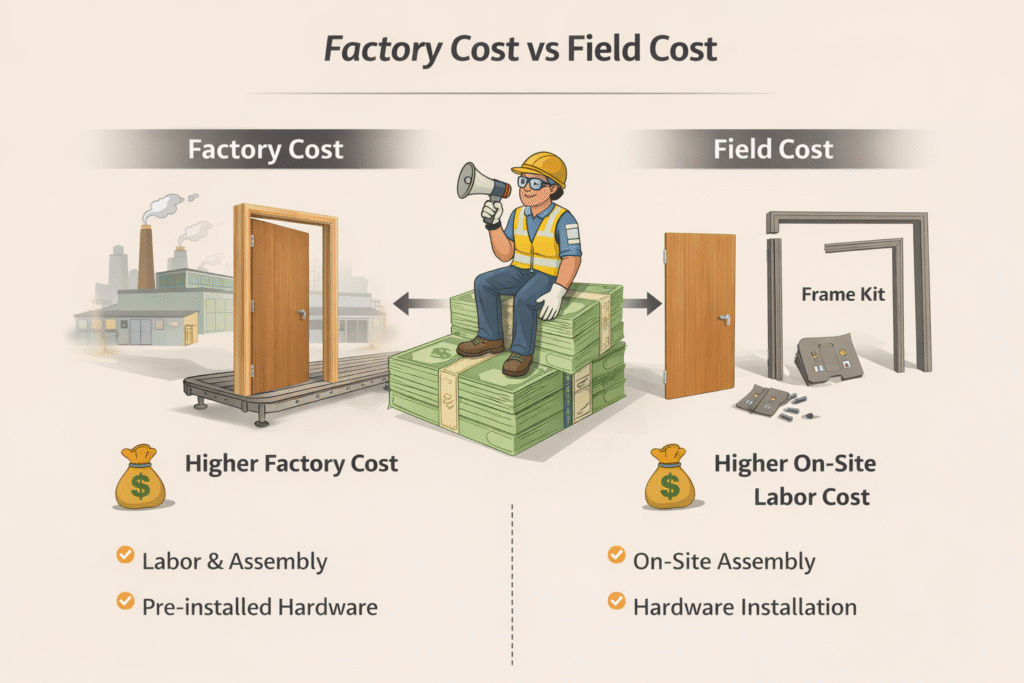
From a procurement standpoint, prehung doors generally carry higher factory pricing due to additional assembly labor and hardware installation. The manufacturer absorbs the cost of alignment and preparation, which increases per-unit pricing compared to a slab-only or KD package.
Knock-down doors typically reduce upfront factory cost. Because components are packaged separately, production labor is lower. However, this savings shifts downstream. The field must absorb assembly time, which may offset factory-level savings depending on regional labor rates.
In high-wage markets such as the United States and Canada, on-site labor often exceeds the incremental factory assembly cost. In these environments, prehung systems frequently demonstrate stronger total installed cost performance despite higher initial pricing.
Freight and Container Efficiency
Freight exposure differs substantially between the two systems.
Prehung doors occupy more cubic volume due to assembled frames. This reduces container loading density and increases shipping cost per unit. For import-driven supply chains, this difference can materially affect landed cost calculations.
Knock-down doors maximize container efficiency. Frames can be nested and slabs stacked separately, increasing unit count per container. Higher loading density improves freight economics and reduces per-door transportation cost.
For projects where ocean freight or long-distance transportation represents a significant budget share, KD systems may offer a structural advantage.

Damage Risk and Quality Control
Damage exposure during transportation and handling also varies.
Prehung units, because of their assembled frames, can be more susceptible to corner or jamb damage if packaging is insufficient. Their bulkier shape requires careful handling at multiple stages of the supply chain.
KD systems distribute risk across separate components. Frames and slabs can be protected individually, potentially reducing visible structural damage during transit. However, field assembly introduces another layer of quality control dependency—alignment precision becomes contingent on installation practices.
Large projects prioritizing uniform appearance across hundreds of units must evaluate where quality control is most reliably maintained: at the factory or on-site.
Schedule and Workflow Considerations
Construction sequencing often favors predictability.
Prehung doors align well with fast-paced multifamily construction, where repetitive layouts and compressed timelines demand standardized processes. Reduced installation variability supports tighter handoff between trades and lowers schedule compression risk.
KD doors may be advantageous in projects with flexible timelines or established installation teams accustomed to frame assembly. In such environments, crews can integrate door preparation into their workflow without significantly extending overall duration.
The broader construction management strategy ultimately influences which system integrates more effectively.
Conclusion
In large-scale construction, the choice between prehung and knock-down doors is a cost-allocation decision rather than a quality judgment.
Prehung doors reduce field labor, stabilize installation time, and enhance schedule predictability—but increase freight volume and factory cost.
Knock-down doors improve container efficiency and reduce shipping exposure—but require greater on-site labor input and installation coordination.
For builders and wholesalers, the most effective approach depends on the relative weight of labor cost versus freight cost within the total project budget. Evaluating door systems through a full installed-cost lens—rather than unit price alone—ensures the decision supports both financial performance and operational efficiency.